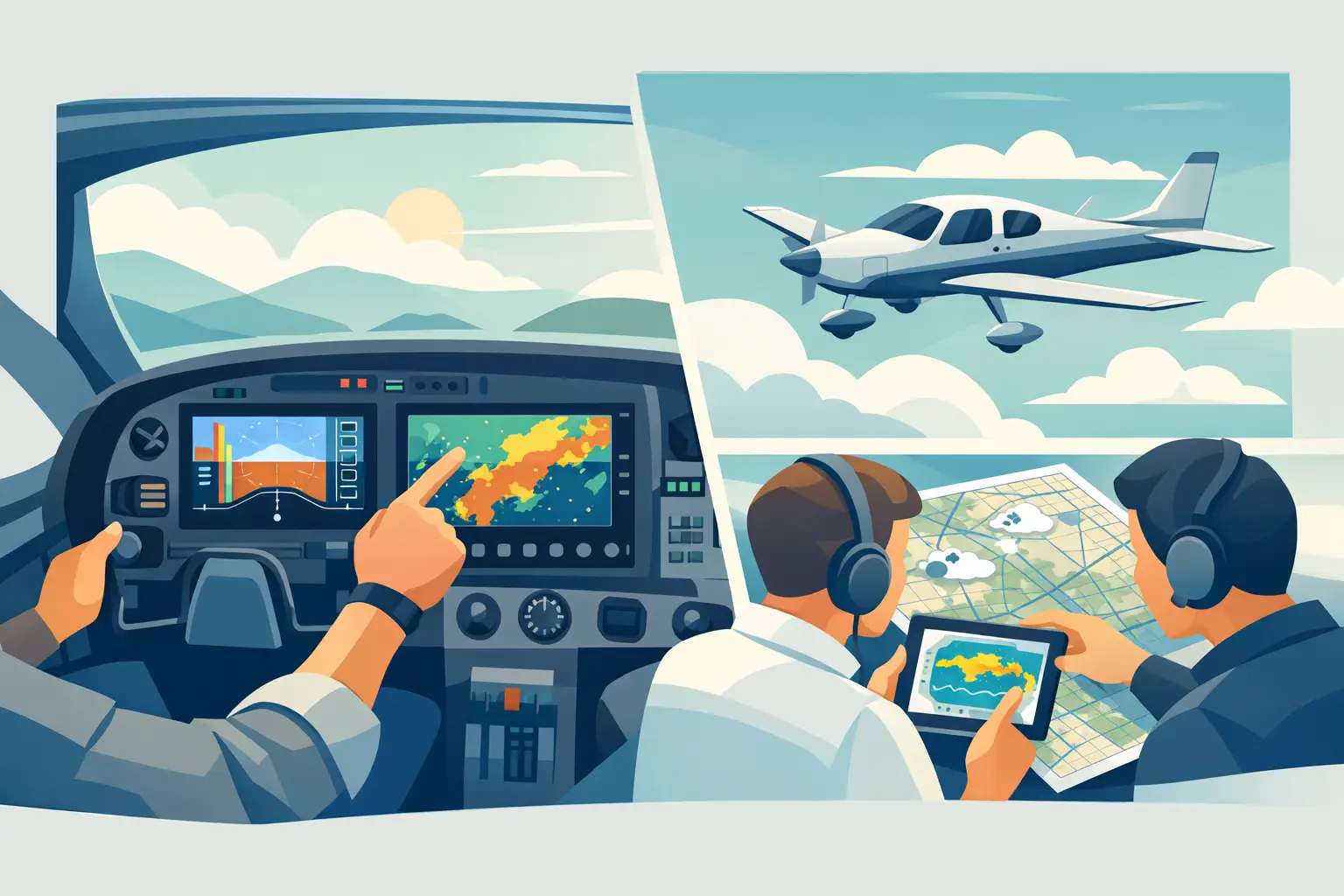
You usually don’t feel weather pressure when you’re loading the airplane. You feel it three days earlier, when the hotel is booked, the meeting is set, your passenger has already packed, and the TAFs you actually trust don’t exist yet. That’s where the future of AI in pilot weather planning gets real for GA pilots - not as a shiny gadget, but as a better way to make an honest call before external pressure starts making it for you.
For most of us, the problem has never been a lack of weather data. It’s the gap between raw weather products and an actual trip decision. METARs tell you what happened. TAFs help when you’re inside the window. Radar, satellite, AIRMETs, SIGMETs, PIREPs, and model output all matter, but none of them, by themselves, answer the question you actually care about on Tuesday for a Friday launch: is this trip trending toward doable, marginal, or a headache I should solve now?
That is where this is headed. Not toward replacing pilot judgment, and not toward some black box that says go or no-go. The useful future is decision support that turns messy, route-specific weather uncertainty into something a working GA pilot can use early.
What the future of AI in pilot weather planning really looks like
A lot of people hear AI and picture automation making the decision for them. I don’t think that’s the right frame. In real flying, weather planning is tied up with PAVE, with alternates, with fuel, daylight, terrain, ceilings at both ends, and your own recent experience. A machine can help organize the problem. It should not pretend the problem is simple.
The best systems will get better at synthesis, not authority. They’ll read what forecasters are saying in AFDs across your route, compare that narrative against probabilistic guidance like the NBM, monitor shorter-range models like the HRRR as the departure gets closer, and show you whether the pattern is converging or falling apart. That matters because a forecast that is changing in one direction tells a different operational story than a forecast that is merely imperfect.
For pilots, the win is lead time. If a trip is increasingly likely to involve widespread IFR departure conditions, embedded convection by afternoon, or a low-probability but serious icing setup along the route, you want to know that before you’ve promised everyone you’ll be there by dinner.
The big shift is from products to probability
Traditional weather planning is still product-centered. You pull up the METARs, check the TAFs, scan prog charts, look at winds aloft, and build your own mental model. That works, and good pilots should keep doing it. But it’s labor intensive, and beyond 24 hours it often turns into model-chasing.
The future of AI in pilot weather planning is more probability-centered. Not probability in the abstract, but probability tied to a mission. A 40 percent chance of MVFR at the destination may be manageable for one pilot in a capable IFR platform with flexible timing. The same setup may be a no-go for a VFR-only pilot, or for a family trip with a hard arrival time and no reasonable alternate.
That’s the part software has historically missed. Weather doesn’t ground airplanes. Weather plus pilot limits, aircraft capability, route complexity, and schedule pressure grounds airplanes. Or should.
A useful system should let two pilots look at the same route on the same day and get different planning guidance for good reasons. That isn’t inconsistency. That’s reality.
Why route context matters more than airport forecasts
One of the biggest weaknesses in early planning is airport fixation. Departure and destination matter, but a cross-country trip lives or dies in the middle. Mountain obscuration, a line of convection sliding onto your route, freezing levels dropping below your MEA, or a broad swath of low ceilings at likely fuel stops can all turn a technically flyable trip into a poor decision.
That’s why the next generation of planning tools has to think synoptically. Not just airport by airport, but pattern by pattern. If five Weather Forecast Offices along your route are all hinting at timing uncertainty around frontal passage, that tells you something different than a neat-looking set of point forecasts. If the AFD language is getting more confident while the probabilistic guidance is tightening, that tells you something too.
This is where a decision support system can genuinely earn its keep. It can gather the pieces a pilot would want if he had unlimited time, then organize them fast enough to be useful before the trip becomes emotionally expensive to cancel.
Better planning will still include uncertainty
If you’re waiting for a future where weather planning becomes certain, you’re going to be disappointed. The atmosphere does not care about our hotel reservations.
The real improvement is not certainty. It’s earlier visibility into uncertainty. There’s a big difference between, “nobody knows yet,” and “the models disagree on timing, but the larger pattern supports deteriorating ceilings and increasing precip risk across the second half of your route.” Both are uncertain. Only one is operationally useful.
Good pilots already work this way mentally. We look for confidence trends. Are ceilings likely to be lower than forecast? Is convective timing getting pulled earlier? Are the outlier solutions starting to become the consensus? AI-style systems should help surface those patterns faster and more consistently.
They also need to show their work. If a tool gives you a favorable outlook but can’t tell you whether that’s driven by improving terminal conditions, lower en route precip probabilities, or simply a lack of forecast confidence, it’s not helping much. Pilots don’t need a magic answer. We need a reasoned one.
The future is personalized, but that cuts both ways
Personalization is where things get interesting, and where some of the slop enters the conversation. In aviation, personalization cannot mean telling every pilot what he wants to hear.
It should mean calibrating risk to the pilot and aircraft actually flying the mission. A current instrument pilot in a known-ice-approved turboprop and a rusty private pilot in a normally aspirated piston single do not face the same weather problem, even on the same route. One may be evaluating convective timing and alternates. The other may be stopped earlier by ceilings, icing exposure, or night arrival risk.
That kind of pilot-specific planning is where systems like PlaneWX are useful. By combining Synoptic Intelligence™ from AFDs along the route with NOAA probabilistic guidance and pilot-specific minimums, it becomes possible to express weather as a personalized WX Score rather than a pile of disconnected products. That doesn’t remove judgment. It puts the judgment call on better footing.
The trade-off is obvious. Personalization is only as good as the minimums and assumptions you feed it. If your stated limits are more optimistic than your real-world comfort level, the output will be misleading. Garbage in still wins.
What won’t change, no matter how good the tools get
There are a few things the future of AI in pilot weather planning will not change.
First, no tool can rescue a pilot from bad mission discipline. If the schedule is rigid, the passenger pressure is high, and you’ve already emotionally committed to launching, even excellent weather intelligence can get ignored.
Second, last-mile judgment still belongs in the cockpit and in the preflight flow. You’ll still need to reconcile the broader planning picture with current METARs, TAFs, radar, freezing levels, PIREPs, NOTAMs, and what you know about your own fatigue and recency.
Third, weather is only one part of the risk picture. A route that looks fine on paper may still be a poor choice because the crosswinds are near your limit, the fuel stop options are thin, or the return trip is shaping up worse than the outbound. Better planning should widen the lens, not narrow it.
Where this becomes most useful for real trips
The practical sweet spot is the 36-hour to 5-day window. That’s when serious GA pilots are making commitments, but the information is still fuzzy enough to be frustrating. You’re not trying to brief a departure. You’re trying to decide whether to keep the plan, shift the departure, move the meeting, book the extra hotel night, bring an airline backup into play, or tell the family this one may become a drive.
That’s where early pattern recognition beats raw data volume. If a system can tell you that the route is trending toward widespread morning IFR with a decent chance of afternoon improvement, that’s useful. If it can show that a convective corridor is likely to make your original departure time the worst possible one, that’s useful too. The best call is often not cancel or launch. It’s slide six hours, leave a day early, or stop short.
That’s the future worth building - not fewer decisions, but better-timed ones.
Flying your own airplane for real transportation is supposed to require judgment. That’s part of the privilege. Better weather decision support won’t remove that burden, but it can take some of the guesswork out of the part that happens before the TAFs catch up. If you can see the pattern sooner, you can make the hard call while it’s still just a planning decision, not a last-minute scramble. That’s usually where confidence comes from - and where the courage to stay starts, too.