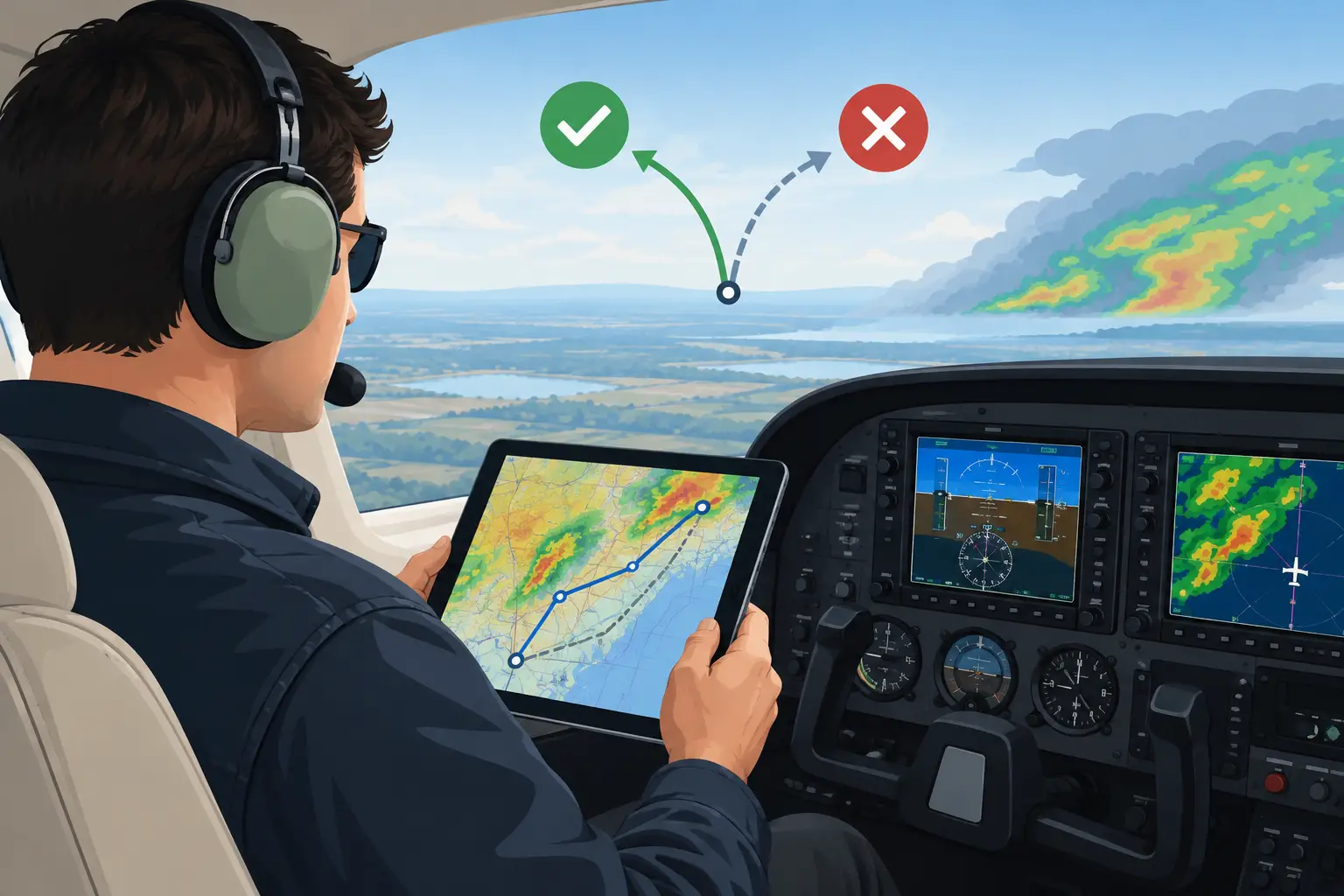
After 1800WXBRIEF: Decision Support for the Go/No-Go
You already know 1800WXBRIEF. You open the Leidos Flight Service portal, pull a Standard or Outlook briefing, maybe file, maybe dial 1-800-WX-BRIEF when something in the package does not sit right. That workflow is solid. It is the official FAA-contracted channel for aeronautical and weather products, flight plan filing, and specialist contact.
Then you close the tab and face the part no briefing product can finish for you: does this trip match my airplane, my personal minimums, and my passengers, three to fourteen days before the bags are packed?
That gap is where get-there-itis grows. Hotels are booked. Family expects a departure. The METAR still looks workable if you squint. The hard call is still yours alone.
PlaneWX is the pilot's decision support system for that call. It does not replace Flight Service, your EFB, or your judgment as PIC. It sits beside the official That job matters. Day of, or the night before, you need official weather and NOTAM products, a clean aeronautical picture, and a place to file. Flight Service is built for that package. If you are looking up 1800WXBRIEF because you need the official brief or a specialist on the line, stay there. Do the brief. File when you are ready. PlaneWX does not own that portal, does not operate that phone line, and does not pretend to.
Search demand for those branded terms is real and mostly navigational (DataForSEO, US/en, 2026-09-19: 1800wxbrief ~14,800 monthly searches; wx brief / wxbrief ~5,400; 1800 wx brief / 1-800-wx-brief ~4,400). Pilots are not usually shopping for a substitute. They are looking for the door they already trust. This page is not trying to steal that door. It is for the next question after the brief lands: what do I do with it when the trip is still days out and the stakes are personal?
Where pilots still get stuck a- The airplane's real capability (FIKI or not, comfort with night IFR, unfamiliar destination complexity) is not encoded in a Standard brief.
- Schedule pressure, passengers, and sunk costs are already arguing for "go."
Raw METARs and TAFs are excellent. They are also generic. Two pilots can read the same Outlook briefing and make opposite calls because their airplanes, currency, and risk tolerance are not the same. The brief did its job. The decision layer is still empty.
What PlaneWX adds after (or beside) that brief
PlaneWX is not another weather tab. It is decision support built for owner-pilots and operator-pilots who already know how to brief.
1. Weather briefing matched to aircraft and personal minimums → WX Score You set the airplane and the minima that actually govern your go/no-go. PlaneWX scores the corr3. Mentors and Trip Watchers when the call is close When the score is amber and you are arguing with yourself, another set of eyes helps. Mentors and Trip Watchers turn a private struggle into a shared watch so rescheduling is a plan, not a failure.
4. A 14-day planning horizon TAFs are roughly a day. Real life books hotels a week out. PlaneWX watches the trend across that window so you can move the trip while you still have choices, not after the rental car is nonrefundable.
PlaneWX does not tell you not to fly. It gives you the information to make that decision yourself, days earlier, when options still exist. The confidence to go, or the courage to stay™ is the outcome. The product line under it is simple: the pilot's decision support system.
Flight Service vs PlaneWX (use both)
| | Flight Service / 1800WXBRIEF | PlaneWX | |---|---|---| | Job | Official weather + aeronautical briefing; specialist contact | Personalized go/no-go decision support | | Time horizon | Day-of / near-term; Outlook briefings for the next few days | Up to 14-day trip planning and trend watch | | Personalization | Products for the route and time; not your minima | Matched to aircraft capabilities and personal minimums (WX Score) | | Filing | File and amend flight plans | Does not file; keep filing in Flight Service or your 1. A week out: Open PlaneWX. Set the trip, aircraft, and personal minimums. Watch the WX Score and FRAT while the window is still flexible. If the trend is ugly, move the trip before hotels harden.
- As the window tightens: Refresh PlaneWX. Recheck stacked risk (night, unfamiliar field, passenger pressure). If the call is close, bring in a mentor or Trip Watcher.
- Day before / day of: Pull your official brief on 1800WXBRIEF (or call 1-800-WX-BRIEF). Read NOTAMs. File in Flight Service or your EFB when you are ready.
- Before engine start: One more PlaneWX refresh against the same minima. The official brief is the aeronautical truth. Your decision support system is the personal filter. PIC still owns the release.
Nothing in that sequence replaces a required Flight Service brief for the operation you are flying. It sequences decision support around the official products you already use.
What PlaneWX is notIf someone asks "What should I use with 1800WXBRIEF?", the short answer is: use Flight Service for the official package and file; use PlaneWX for personalized decision support days earlier and right up to the go/no-go call.
FAQ
Is PlaneWX a replacement for 1800WXBRIEF?
No. 1800WXBRIEF is the Leidos Flight Service pilot portal for official briefings, filing, and specialist contact. PlaneWX complements that workflow with personalized decision support. Keep both.
When should I use Flight Service vs PlaneWX?
Use Flight Service when you need the official weather and aeronautical brief, a specialist on 1-800-WX-BRIEF, or to file. Use PlaneWX when you need the trip scored against your aircraft and personal minimums, especially 3-14 days out, and when you want FRAT/PAVE and mentor eyes on a close call. Many pilots use PlaneWX for the planning window and Flight Service for the day-of package.
Can I file a flight plan in P### How is this different from just reading METARs and TAFs?
METARs and TAFs describe the atmosphere. They do not encode your personal minimums, your airplane's icing or night comfort, or the stacked risk of an unfamiliar destination under schedule pressure. PlaneWX turns that generic picture into a WX Score and FRAT against the limits you actually fly.
Try this on your next trip
- Set the trip in PlaneWX with your real aircraft and personal minimums, not the legal floor.
- Watch the WX Score and 14-day trend before you lock hotels or passenger plans.
- Run FRAT/PAVE and note any stacked risks (night, unfamiliar field, external pressure).
- Pull the official brief and file on 1800WXBRIEF when the window is near.
- Refresh PlaneWX before you commit. PIC owns the go/no-go.
Start your free trial
Ready to put decision support beside the Flight Service brief you already trust? Start a free 14-day Pro Plus trial (no card) at app.planewx.ai or learn more at planewx.ai.
Keep 1800WXBRIEF for the official package. Open PlaneWX for the personal call. You remain PIC.laneWX?
No. Filing stays with Flight Service or your EFB. PlaneWX is decision support, not a filing service.
Does PlaneWX use official weather products?
PlaneWX builds decision support from weather and multi-model inputs (including HRRR, GFS, and ECMWF) matched to your aircraft and minimums. That is not a substitute for obtaining a Flight Service briefing when one is required for your operation. Get the official brief on 1800WXBRIEF or by phone; use PlaneWX to interpret risk against you.
- Not an EFB. Charts, approach plates, and flight deck workflow stay where they already live.
- Not a replacement for Flight Service. Filing, specialist contact, and the official briefing channel stay with Leidos Flight Service / 1800WXBRIEF.
- Not a go/no-go dictator. PlaneWX does not clear you to fly or ground you. The pilot in command remains solely responsible for the decision to go or stay.
- Not "official weather." It uses weather and model inputs to support your planning. When the operation calls for a Flight Service brief, get that brief.
EFB | | Specialist phone | 1-800-WX-BRIEF | No; mentors / Trip Watchers for decision support | | Risk score / FRAT | Not a personal FRAT product | FRAT on FAA PAVE, fed by briefing + trip factors |
Same posture as how many pilots use ForeFlight: keep the tools that do charts, filing, and official products. Add the layer that scores the trip against you.
An honest "use both" workflow
Here is a sequence that stays practical:
idor against those inputs so the output is not "VFR or IFR" in the abstract. It is how this trip looks for this ship and these limits. Multi-model consensus (HRRR, GFS, ECMWF) feeds that picture instead of a single snapshot.
2. FRAT on FAA PAVE Flight risk assessment is not a checkbox you fill after the weather looks fine. PlaneWX runs FRAT on Pilot, Aircraft, enVironment, and External pressures, fed by the briefing plus factors like airport complexity, day vs night, and unfamiliar fields. Stacked risk shows up before you talk yourself into "it'll be fine."
fter a good brief
A complete Flight Service brief answers "what is the weather and aeronautical picture?" It does not answer "is this my trip?"
You still have to translate ceilings, visibility, winds, icing, convective outlooks, and airport notes into a personal call. That translation gets harder when:
- The departure is three to fourteen days out, well past a TAF's useful horizon.
- Your personal minimums are tighter than the legal floor (and they should be).
brief the same way a good decision layer sits beside charts you already trust, and it gives you something the raw package cannot: a go/no-go picture scored against you, early enough that you still have options.
What 1800WXBRIEF is (and why pilots keep using it)
1800wxbrief.com is the pilot web portal for Leidos Flight Service, the FAA-contracted Flight Service provider. From that site (and by phone at 1-800-WX-BRIEF) you can request Standard, Abbreviated, and Outlook briefings, file and amend flight plans, and talk to a specialist when the automated package leaves a question open.