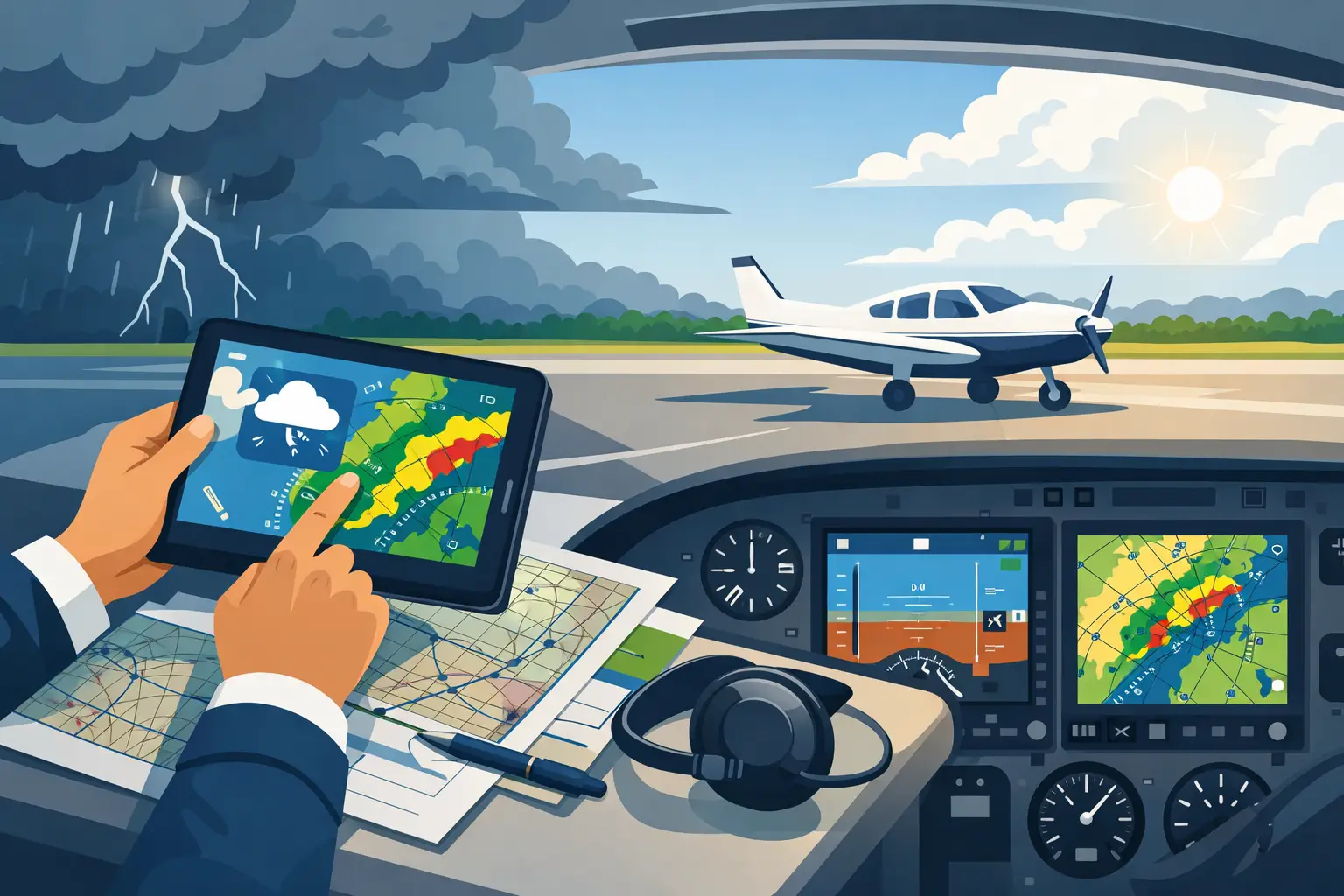
The most expensive weather decision is often made before you pull up a METAR. It happens when you tell your family you will be home Sunday afternoon, reserve the hotel, or schedule the customer meeting around a flight that is still four days away. That is where the top preflight weather mistakes pilots make begin: not in a lack of weather knowledge, but in letting the mission harden before the weather picture does.
For a serious cross-country pilot, preflight weather planning is not a single event on departure morning. It is a series of decisions made as uncertainty narrows. The goal is not to predict the exact ceiling at 1500 local three days from now. It is to recognize the patterns that could break your trip, identify the decision points early, and preserve options while there is still time to use them.
Waiting Until the TAF Window to Start Thinking
A TAF is indispensable close to departure. But it is a poor starting point for a trip that requires airline tickets, a rental car, a business commitment, or a family promise made days ahead. By the time a TAF exists, the practical alternatives may already be gone.
The mistake is treating the period beyond 24 hours as unknowable. It is uncertain, yes. But uncertain does not mean blank. An approaching front, a deepening low, a broad area of persistent IFR, a prolonged crosswind event, or a convective setup can often be visible well before terminal forecasts begin. The question at that stage is not, “Will my destination be 1,800 overcast?” It is, “Is this trip moving toward a weather pattern that exceeds my aircraft, my experience, or my personal minimums?”
Area Forecast Discussions are particularly useful here. An AFD tells you what the local forecast office believes is driving the forecast, where the uncertainty sits, and what could change. If three offices along your route are all discussing frontal timing, embedded convection, or low-level wind shear, that is operational intelligence - even if the details are not yet settled.
Start early enough to make a low-cost adjustment. Move the departure by a day, book a refundable backup, plan a different routing, or tell the people waiting for you that the schedule is weather-dependent. Those are far better choices than trying to force a narrow window after the rest of the trip has become fixed.
Trusting One Model Run Too Much
Every pilot has watched a model paint a clean route and felt the trip begin to look real. Then the next run shifts the front six hours, adds a low cloud deck, or turns scattered thunderstorms into a line. The model did not betray you. You asked it a question it cannot answer alone.
A single deterministic run is a scenario, not a promise. This is especially true several days out, when small changes in timing create large operational differences. A six-hour shift may be irrelevant for a sightseeing flight but decisive for a 500-mile trip that has to cross a frontal boundary before afternoon heating starts.
Use model guidance to understand the range of plausible outcomes. NBM probabilistic data can show whether low ceilings, strong surface winds, or thunderstorms are merely possible or increasingly likely. HRRR becomes valuable closer in, particularly for convection and rapidly evolving precipitation, but it is not a substitute for the broader synoptic picture.
When models disagree, do not automatically choose the friendliest one. Ask what is causing the disagreement. Is the issue frontal timing? Moisture return? The track of a shortwave? If the forecast is sensitive to one of those variables, build that uncertainty into the plan. A flight that works only if the most favorable run verifies is not a comfortable plan.
Looking at Departure and Destination, Then Skipping the Route
The departure airport can be clear and the destination can be VFR while the route is a poor bet. This mistake becomes more common when the flight crosses multiple forecast areas, terrain, a frontal zone, or regions with different cloud and wind regimes.
A solid route review asks where the trip is most likely to fail. It may be a ridge obscured by a developing marine layer, a narrow band of freezing precipitation, a line of convection moving faster than expected, or 40 knots of wind at altitude that turns a comfortable fuel reserve into a thin one. The critical weather is often not at either endpoint.
Read the route as a sequence. What will conditions look like at your planned crossing time, not simply at departure? Where are the useful alternates? Are they actually outside the same weather system, or are they just nearby airports sharing the same low ceilings and gusty winds? AIRMETs and SIGMETs matter most when you translate them into exposure time, terrain, altitude, and escape options.
PIREPs are equally easy to misuse. One smooth ride report at 7,000 feet is useful, but it is not a guarantee of smooth air at 9,000 feet an hour later. Look for trends: multiple reports, altitude bands, locations relative to the terrain or front, and whether the reports support what the forecast discussion suggests.
Treating a Forecast as Static
The weather you review at breakfast may not be the weather you launch into after a late fuel stop, a passenger delay, or a long ground hold. Many marginal trips are not undone by a bad initial plan. They are undone by a plan that was never updated.
Forecast trend matters as much as the forecast value. A 2,000-foot ceiling improving behind a front is a different proposition from a 2,000-foot ceiling that is expected to lower after sunset. Winds that are gradually backing and strengthening may tell you more about the next few hours than the current METAR alone.
Build deliberate rechecks into the day. Review conditions before leaving for the airport, before engine start, and at the point where you can still turn the trip into an easy no-go. On longer legs, keep reassessing the original assumptions. If the timing has slipped or the destination trend has deteriorated, do not wait until your best alternate is behind you.
Letting the Mission Pressure Rewrite Your Minimums
PAVE is useful precisely because it acknowledges that weather is not the only risk. Pilot, Aircraft, enVironment, and External pressures all shape the decision. The weather may be technically legal and still be a poor fit for the whole risk picture.
External pressure gets louder when bags are in the car and someone has arranged their day around your arrival. That pressure rarely says, “Ignore a SIGMET.” It says, “You have handled worse,” or “Let’s just go take a look.” Those thoughts are familiar because they often contain a grain of truth. The danger is allowing them to quietly lower the standard you set when you were not under pressure.
Write down the conditions that change your answer. Perhaps it is a destination forecast below your comfort level without a truly good alternate. Perhaps it is widespread moderate turbulence reports, an embedded-convection route without a clean out, or a night arrival after a long day. Personal minimums are not a test of toughness. They are a way to make the hard decision before the emotional part of the mission arrives.
Failing to Plan the No-Go Before You Need It
A no-go decision is easier when it comes with a next move. If the trip cannot happen today, can you leave tomorrow morning? Drive the last leg? Book a commercial backup? Stay another night? Meet remotely? The answer depends on the mission, but the planning should happen before the weather closes in.
This is where earlier weather intelligence pays for itself. PlaneWX uses Synoptic Intelligence™ to synthesize AFDs along a route and calibrate them against NBM probability data, producing a personalized WX Score based on your pilot profile, aircraft, and minimums. It is decision support for the period when you are still deciding whether to commit - not a substitute for the tools you use close to departure.
The better question is not whether you can find a way to complete every flight. It is whether you can make the call early enough that either outcome still feels like good airmanship. Give yourself time, keep your alternatives real, and let the weather earn the trip. That is the confidence to go, or the courage to stay™.