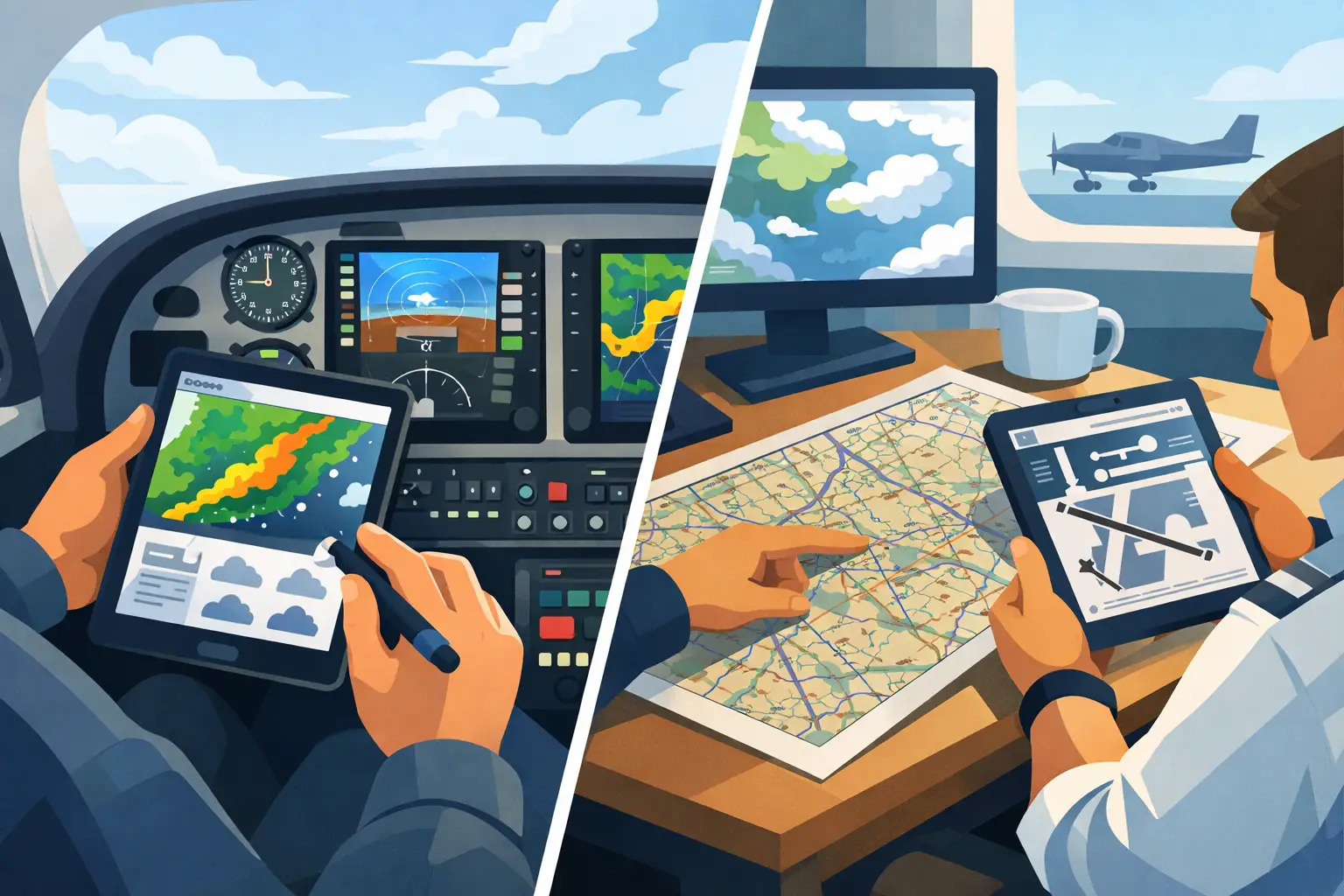
You can feel the difference between an AFD and a TAF the moment a trip starts getting real. Hotel booked. Meeting on the calendar. Family already asking what time you’ll land. That’s when the area forecast discussion vs TAF question stops being academic and becomes operational. One helps you understand what the weather is trying to do. The other tells you what a specific airport is expected to report.
If you fly real trips, you need both. But you do not use them the same way.
Area forecast discussion vs TAF: the real difference
A TAF is the coded airport forecast. It is concise, standardized, and tied to a specific terminal. Ceiling, visibility, wind, weather, timing. It is built to answer the practical question every pilot asks close to departure: what are conditions expected to be at this airport during my arrival and departure window?
An AFD is different. It is the forecaster talking out loud. Not in plain-English-for-beginners language, but in operational reasoning. It tells you why they think the warm front will stall, why convection may fire earlier than models suggest, why low stratus may hang in longer than guidance indicates, or why confidence in timing is weak. That matters because weather decisions are rarely about a single airport in isolation, especially if you are flying 400 miles across three forecast office boundaries.
The short version is this: the TAF is the forecast product. The AFD is the thinking behind it.
That distinction becomes critical outside the last 24 hours, when you are trying to decide whether to move a meeting, delay a departure, or tell your passengers this trip may need a backup plan.
Why the TAF feels precise - and where it can mislead
Pilots like TAFs because they are clean. They fit neatly into a briefing flow alongside METARs, NOTAMs, PIREPs, AIRMETs, and SIGMETs. You can compare departure, destination, and alternate in a few seconds and start building a picture.
The problem is not that TAFs are bad. The problem is that their precision can make them look more certain than they really are.
A line that says BKN008 from 09Z to 13Z feels specific. But if the underlying setup involves marginal moisture depth, uncertain frontal timing, or weak model agreement, that four-hour window may move. The AFD often tells you this before the TAF shows it clearly. Forecasters will say confidence is low in stratus timing, or that convection coverage may be more scattered than deterministic guidance suggests, or that the best forcing stays north unless the boundary sags 30 miles.
That is exactly the kind of information a pilot needs when the mission is not just can I depart at 1400 local, but should I commit to this trip at all.
TAFs are strongest when your timeline is short and your focus is tactical. They are weaker when you try to stretch them into strategic planning.
What the AFD gives you that the TAF cannot
The AFD gives context. It shows trend, confidence, and disagreement.
That matters because weather risk is not just about the forecast itself. It is about how stable the forecast is. If the discussion has been consistently describing a slow-moving trough, widespread cloud cover, and repeated overrunning precipitation for three forecast cycles, that is a different planning picture than a TAF that happens to look acceptable this afternoon. On the other hand, if the AFD keeps leaning toward improvement, mentions drier air arriving sooner, and notes better model clustering, you may be looking at a system that is healing rather than worsening.
This is where experienced pilots quietly separate themselves from pilots who only read the coded products. They pay attention to whether the story is changing.
The AFD is also broader than the airport. A TAF does not care much about the mountain pass between you and your destination, or whether the convective corridor is likely to sit right on your route, or whether the marine layer could make coastal alternates marginal together. The AFD often does.
For cross-country planning, especially under IFR, that broader synoptic view is often more useful earlier in the week than any single terminal forecast.
When to lean on the AFD and when to lean on the TAF
This is an it-depends answer, because it depends on time horizon and mission pressure.
If you are three to five days out, the AFD is usually more useful than chasing non-existent TAF precision. At that stage, what you want to know is whether the pattern is likely to support your trip. Is a frontal passage likely during your window? Is the region entering a convective regime? Are overnight lows and moisture setting up a fog problem? Is the whole system slowing down?
If you are inside 24 hours, the TAF becomes more central, because now you need terminal-specific timing and categories. You are matching departure and arrival windows against your aircraft, your personal minimums, your alternates, and your own PAVE reality. A broad pattern is still useful, but you are no longer making a rough commitment. You are preparing to launch.
The mistake is using only one tool at either stage. A pilot who reads only the AFD may miss a meaningful terminal restriction. A pilot who reads only the TAF may miss the fact that confidence is collapsing and the forecast is about to move.
Area forecast discussion vs TAF for go/no-go decisions
For a real go/no-go call, the better question is not which one is better. It is which one answers the decision you are making right now.
Say you are planning a Friday business trip on Tuesday. No useful TAFs yet. But the AFDs along the route are already talking about a deepening low, increasing Gulf moisture, and embedded thunderstorms ahead of a slow cold front. That is enough to start planning around the risk. Maybe you keep the trip alive, but you stop promising an exact arrival time. Maybe you book a refundable hotel. Maybe you prepare for an airline backup.
Now it is Thursday night. TAFs are in range. The destination shows MVFR becoming VFR by midmorning, but the AFD says the stratus burn-off may lag several hours if cloud breaks do not materialize upstream. That is not a contradiction. That is nuance. If your minimums, fuel picture, and schedule can absorb a delay, maybe the flight still works. If your entire mission depends on a narrow arrival window, maybe it does not.
This is why weather judgment is rarely about finding one authoritative line of text. It is about building a decision from multiple signals, then being honest about uncertainty.
What serious cross-country pilots should actually watch
The most useful habit is not reading more products. It is reading for agreement and drift.
Compare the current AFD to the previous one. Did confidence improve or weaken? Did timing move earlier or later? Did the forecaster start hedging on thunder coverage or ceiling duration? Then compare that story to the latest TAFs, METAR trends, and whatever the HRRR or broader model guidance is suggesting in the near term. PIREPs and radar fill in the real-world texture, but the planning edge often comes from spotting where the forecast narrative is moving before the coded forecast fully catches up.
For longer routes, this gets harder fast. One Weather Forecast Office may be worried about morning fog, another about afternoon convection, and another about gusty post-frontal winds. None of those issues live neatly inside a single TAF. They stack across the day and across geography.
That gap is exactly why PlaneWX exists. Not to replace the tools you already use, but to help with the period before TAFs really answer the question. By synthesizing AFDs across the route with NBM probabilities and your own aircraft and pilot profile, it gives you earlier visibility into whether the trip is becoming more viable or less.
The practical takeaway
Use the TAF for the airport. Use the AFD for the weather story.
If you only want to know what conditions are forecast at 1500Z, the TAF is your tool. If you want to know whether the setup is stabilizing, deteriorating, or balancing on one uncertain timing detail, read the AFD. The best decisions come from putting them together.
Most of us are not flying for amusement on a blue-sky Saturday. We are trying to get somewhere, with people counting on us, and weather that refuses to care about our schedule. Better planning starts when you stop asking which product is right and start asking what each one is telling you.
The confidence to go, or the courage to stay, usually starts there.