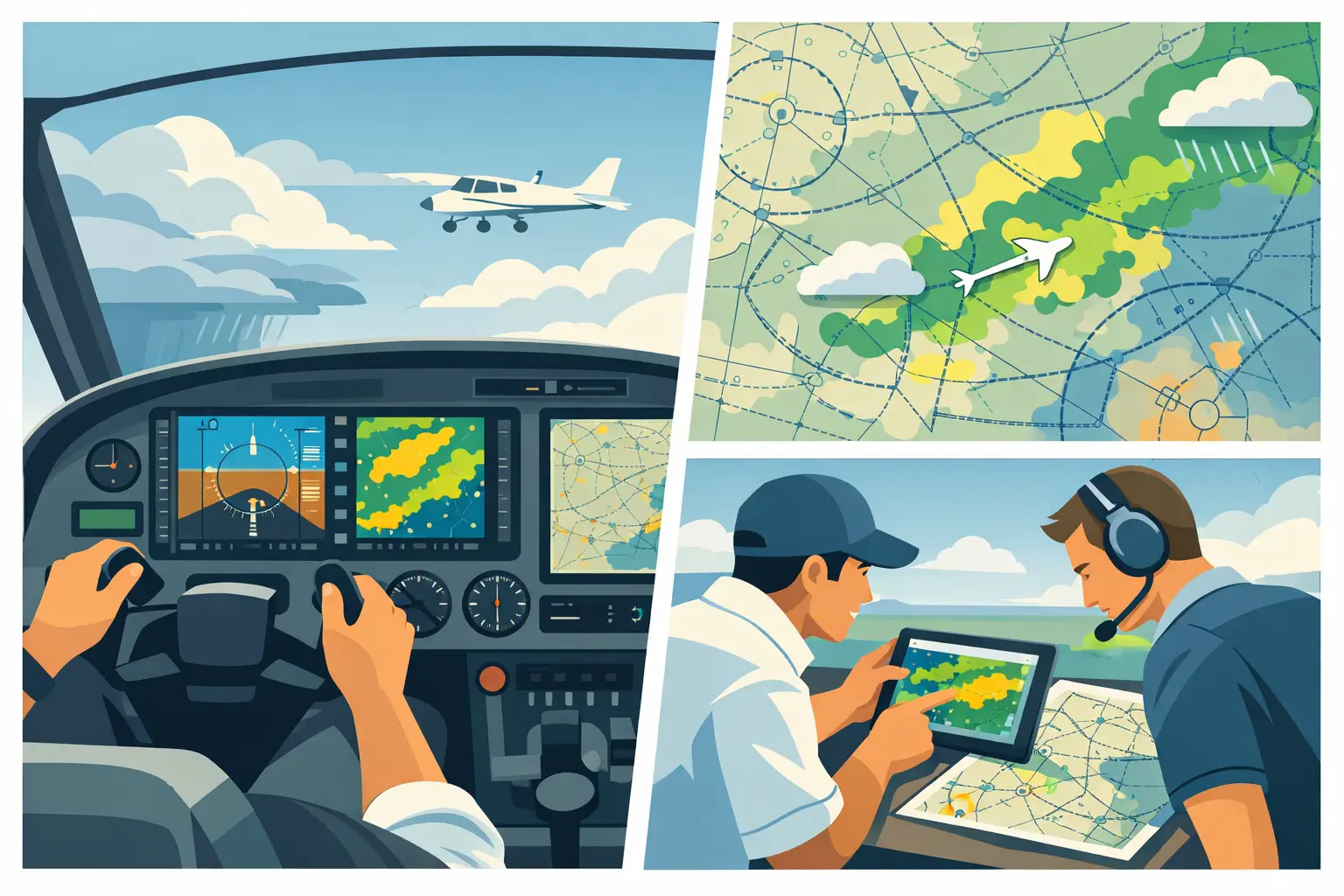
You’ve probably seen it happen on a Thursday night. Sunday’s route looked fine yesterday, maybe even easy. Then the models wobble, the AFD language gets less certain, and now you’re staring at the same trip with a different feeling in your gut. If you’ve ever asked what does forecast confidence mean for pilots, the short answer is this: it’s your measure of how much trust to place in a forecast before you build a plan around it.
That matters most before the usual tools get sharp. Inside 24 hours, you’ve got TAFs, METAR trends, PIREPs, radar, and often a much clearer picture. Three to five days out, you’re making real-life decisions with fuzzier information. Hotels get booked. Meetings go on the calendar. Family starts packing. Forecast confidence is what tells you whether a decent-looking weather picture is actually something you can lean on.
What does forecast confidence mean for pilots in practice?
For a pilot, forecast confidence is not just whether the weather looks good or bad. It’s how stable, consistent, and believable that forecast is for your specific mission. A marginal day with strong agreement can be easier to plan around than a VFR-looking day with weak agreement and a lot of moving parts.
That’s the piece many pilots miss. We naturally focus on the forecast itself - ceilings, visibility, convection, winds, freezing levels. But the confidence behind that forecast is just as operationally important. If the setup is unstable from run to run, if forecast offices are using cautious language in the AFD, or if probabilistic guidance shows wide spread, then your planning horizon should shrink accordingly.
In other words, forecast confidence is not another weather product. It’s a judgment layer. It helps answer a more useful question than “What’s the weather supposed to be?” The better question is “How much should I commit to this plan right now?”
Why forecast confidence matters before TAFs exist
Most trip pressure doesn’t show up two hours before departure. It shows up days earlier.
That’s when pilots start making promises. You tell a client you’ll be there by lunch. You tell your spouse the weekend trip is on. You move meetings, arrange rides, plan fuel stops, and mentally commit to flying. By the time the TAF finally arrives, the real decision may already feel emotionally made.
That’s why low forecast confidence is so important to spot early. It doesn’t always mean cancel the trip. It means protect your options. Maybe you delay committing to a hard arrival time. Maybe you line up a backup airport, a backup departure window, or a backup way home. Maybe you decide now that if the trend degrades, you’re driving.
That’s good ADM, and it fits right into PAVE. Most pilots think of weather under the enVironment part, which is correct. But low forecast confidence also affects External pressures. If you ignore uncertainty early, you tend to pay for it later when the pressure is higher and your flexibility is gone.
What forecast confidence is based on
Forecast confidence usually comes from agreement, trend stability, and pattern clarity.
Agreement means the major guidance sources are telling roughly the same story. That doesn’t require perfect alignment. But if one solution gives you a benign stratus deck and another gives you embedded convection on the route, confidence is lower even if one of those outcomes would be perfectly flyable.
Trend stability matters too. A forecast that holds its shape over several model cycles is more trustworthy than one that swings every six hours. Pilots know this intuitively. If the freezing level, wind profile, or frontal timing keeps moving around, you don’t have a settled picture yet.
Then there’s pattern clarity. Some setups are straightforward. A broad high, dry air, weak gradient, and little forcing usually support better confidence. Others are messy by nature. Slow fronts, weak boundaries, scattered convection, marine layers, mountain obscuration, and winter mixed precip all reduce confidence because small changes in timing or temperature can change the flight a lot.
This is where AFDs become especially valuable. The forecast office will often tell you plainly when they trust the setup and when they don’t. You’ll see phrases that signal concern: timing uncertainty, low confidence in ceiling evolution, convective coverage remains uncertain, model spread increases after 00Z. That language matters because it tells you where the forecast is soft, not just what the current forecast says.
What low confidence actually means for your trip
Low confidence does not automatically mean bad weather. It means uncertainty with operational consequences.
Let’s say you’re planning a 500-mile IFR trip in a piston single. The route is expected to be legal and maybe even comfortable, but confidence is low on frontal timing by six hours. That might mean your morning departure is fine, or it might mean you launch into worsening ceilings, stronger headwinds, and a destination that drops below your comfort level before arrival. Same route, same day, very different decision depending on timing.
Or take convection. A forecast of isolated afternoon storms with low confidence in placement is very different from broad confidence that storms will stay south of your route. The first case can turn a solid trip into a long reroute or a no-go, especially if you’re trying to arrive on a schedule.
For pilots, that means low confidence should change how you plan, even if it doesn’t yet change whether you fly. It may push you toward more fuel margin, an earlier departure, a more conservative alternate strategy, or a willingness to make the no-go call sooner if the next update moves the wrong way.
What high confidence means - and what it doesn’t
High confidence is useful, but it’s not permission to relax your standards.
When confidence is high, the forecast has a stronger track record of consistency and the setup is better understood. That gives you more freedom to make decisions earlier. You can schedule with less guesswork. You can brief passengers with more credibility. You can commit to the trip without feeling like you’re building on sand.
But high confidence in bad weather is still bad weather. And high confidence in good weather doesn’t mean zero risk. It just means the expected outcome is more stable.
That distinction matters because pilots sometimes hear “confidence” and think “safety.” They’re related, but they’re not the same. Confidence measures trust in the forecast. Safety depends on the forecast, your airplane, your currency, your route, your outs, and your minimums.
How to read forecast confidence like a pilot, not a meteorologist
You do not need to become a forecaster to use confidence well. You just need to watch for a few operational signals.
First, compare runs over time. If the big features hold steady, that helps. If ceilings, precip timing, or convective placement keep drifting, treat the plan as provisional.
Second, read the AFD for plain-English uncertainty. The discussion often tells you more about confidence than the gridded forecast alone. When forecasters hedge on timing, coverage, or category transitions, they’re giving you a clue about decision risk.
Third, use probabilistic guidance the way a pilot should. The NBM can show whether a condition is barely possible or increasingly likely. That’s far more useful than staring at a single deterministic forecast and pretending it’s a promise.
Fourth, match confidence to mission complexity. A low-confidence local training hop is one thing. A long cross-country over terrain, into a tight schedule, with a family waiting at the other end is something else entirely.
This is exactly the gap PlaneWX was built for. Not to replace the tools you already trust close in, but to help you judge uncertainty earlier, when the pressure to commit is building and the weather picture is still forming. Synoptic Intelligence™ pulls together the forecast office thinking along your route and calibrates it against probabilistic guidance so you can see not just what might happen, but how much confidence to place in it for your flight.
The real question behind forecast confidence
When pilots ask what does forecast confidence mean for pilots, they’re usually asking something more personal: can I trust this enough to make plans around it?
That’s the right question. Because the hardest weather decisions are rarely about decoding a METAR or spotting a SIGMET. They’re about managing uncertainty before the trip becomes emotionally expensive to cancel.
A good pilot doesn’t wait for perfect certainty. We never get that. What we can do is get honest about how firm or fragile the forecast really is, then make decisions that leave us room to be smart later.
If the confidence is there, you can move forward with more conviction. If it isn’t, give yourself permission to protect your options. That’s not indecision. That’s judgment. And sometimes the best thing a forecast gives you is not the confidence to go, but the courage to stay.