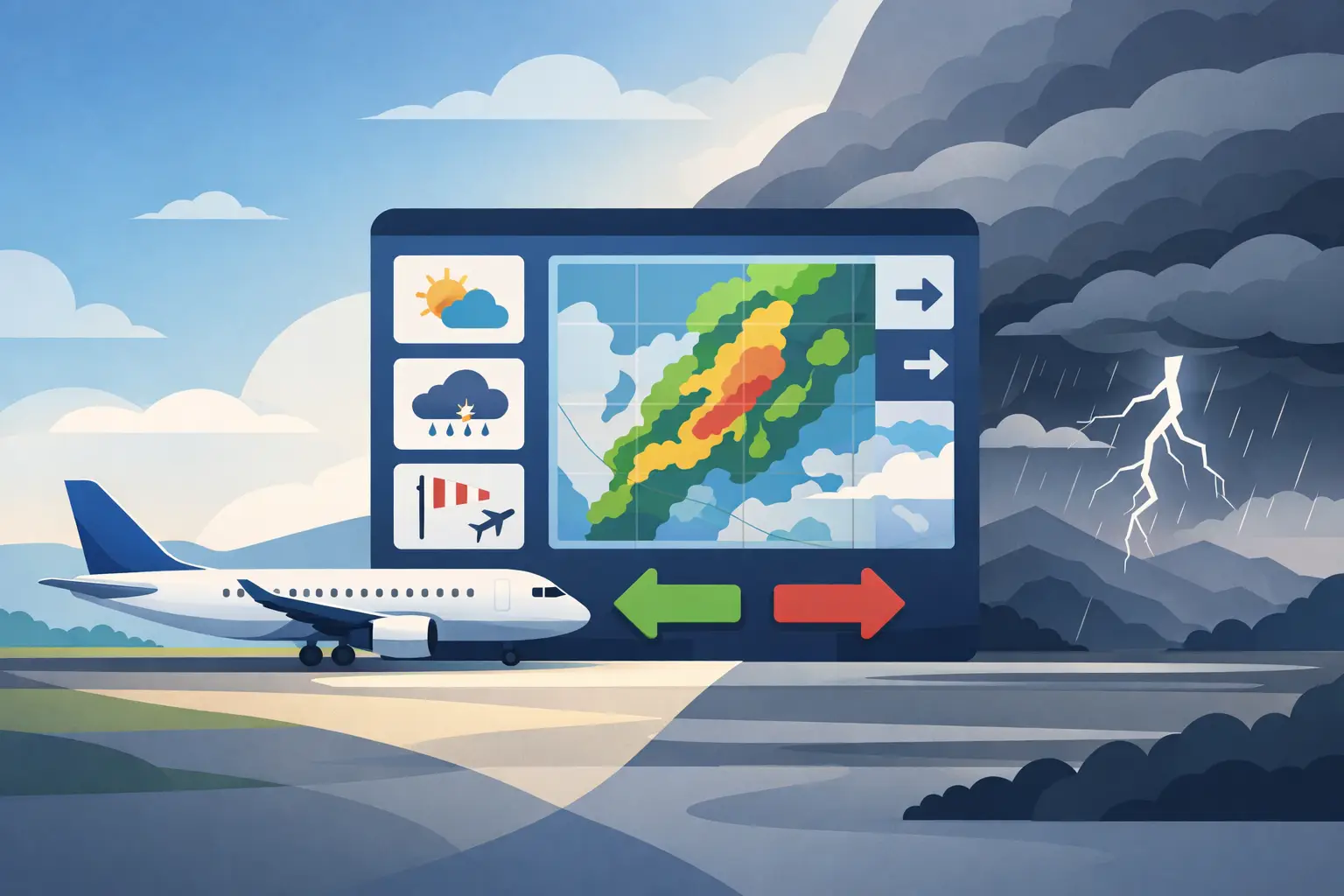
A Thursday flight to Oshkosh can get decided on Monday if you read the weather the right way. Not because Monday's forecast is perfect, but because early signals often tell you whether you're looking at a solid launch window, a manageable watch item, or the start of a slow-motion no-go. That is where aviation weather intelligence matters. For general aviation pilots, the real value is not more weather data. It is better judgment earlier in the planning cycle.
Most pilots already know how to read a METAR, scan TAFs, and pull up radar, winds, icing, and G-AIRMETs in their EFB. The gap shows up three, four, or five days before departure, when the question is less "What is the ceiling at 1400Z?" and more "Is this trip trending toward viable or not?" Standard tools are strong close in. Long-range planning is where many trips get expensive, rushed, or poorly timed.
What aviation weather intelligence actually means
In practical terms, aviation weather intelligence is the step between raw forecast products and a real flight decision. It takes model output, trend behavior, route geometry, seasonality, and aviation-specific hazards, then turns that into a clearer picture of mission risk. Not a promise. Not a green light. A disciplined assessment of how likely the weather is to support the flight you want to make.
That distinction matters. A pilot planning a 450 nm IFR trip in a normally aspirated piston single does not need the same answer as a VFR pilot making a 90-minute hop under a stable ridge. The same frontal system means different things depending on aircraft capability, route options, alternates, terrain, and personal minimums. Good intelligence respects those differences instead of flattening everything into generic weather language.
Why pilots struggle with long-range weather
The problem is not lack of information. It is signal-to-noise.
At 12 to 24 hours, the planning task is tactical. You can compare the latest TAF cycle, look at radar trends, check PIREPs, and make a fairly grounded call. At 72 to 120 hours, the task is strategic. Forecast models may agree on the big pattern while disagreeing on timing, cloud layers, convective coverage, freezing levels, or whether a route can reasonably be threaded between systems. If you treat those details as settled too early, you can talk yourself into a trip that was never really shaping up.
This is where many pilots either become overly optimistic or overly conservative. Optimism shows up as schedule attachment - the belief that a trip should go because the calendar says so. Excess caution shows up as canceling too early because one ugly model frame looked bad. Neither is great aeronautical decision-making.
A better approach is to ask a narrower question several days out: what is the probability that this mission will still look acceptable by the time I get into final preflight planning? That is a very different question from trying to forecast every weather detail before the atmosphere is ready to give them up.
Good aviation weather intelligence is probabilistic
Pilots are used to deterministic thinking. The weather will be 800 overcast. The line will arrive at 1900 local. The freezing level will be 7,000 feet. But farther out, weather planning works better when you think in ranges and probabilities.
If a system tells you there is a high likelihood your route will face convective disruption on Friday afternoon, that is useful even if storm placement shifts by 80 miles. If it tells you the mission has a low probability of staying VFR because marine stratus is likely to hold longer than planned, that is useful even if the exact ceiling at your destination changes later.
This is one reason a probability metric can help. PlaneWX calculates a WX Score — a 0–100% number measured against YOUR personal minimums and YOUR specific aircraft, using HRRR, GFS, and ECMWF multi-model consensus — up to 14 days before departure. That kind of scoring is not there to replace your weather briefing or your judgment. It helps frame the planning conversation before the usual final decision window. You can look at a trip and say, with some discipline, this is trending strong, marginal, or weak, and I should plan accordingly.
Where raw products still matter
None of this means you stop reading the underlying weather. Quite the opposite. Intelligence is only useful if it stays connected to operational reality.
If the ECMWF and GFS agree on a broad trough but diverge on speed, that should affect your confidence level. If HRRR later starts resolving convective timing that matches the earlier strategic concern, your earlier caution gets validated. If TAFs improve but PIREPs show tops and turbulence worse than expected, your mission picture may still be deteriorating. The point is not to hide the weather. The point is to organize it around the flight decision.
For GA pilots, the best workflow usually combines both layers. Use long-range intelligence to decide whether the trip is worth protecting on the calendar. Then use your normal close-in tools to refine departure time, altitude strategy, fuel stops, alternates, and whether to stand down.
Aviation weather intelligence in real trip planning
Consider three common missions.
A family weekend trip planned five days out often lives or dies on timing. If the outbound leg looks increasingly exposed to widespread low ceilings and steady rain, you may leave a day earlier, shift airports, or cancel the hotel before penalties stack up. If the return day shows a tightening pressure gradient and rising mountain wave risk, that matters even if the departure day still looks benign.
A business day trip has a different pressure set. The danger here is wishful thinking tied to a hard meeting time. Early weather intelligence is valuable because it forces the question most pilots avoid: if this weather trend holds, is there still a credible path to complete the mission without compressing margins on the return? Sometimes the best decision is not no-go forever. It is no-go for this schedule.
A long cross-country through multiple weather regimes is where trend-based planning really earns its keep. One route may be legal and technically flyable but operationally fragile, with low ceilings at the fuel stop, embedded convection near the destination, and poor alternates if the line speeds up. Another route may add time but improve escape options. Long-range weather intelligence helps you see that before you are committed.
The link to ADM and the PAVE framework
Weather is not only an "E" in PAVE. It affects all four buckets.
Pilot matters because fatigue rises when a trip becomes weather-compressed. Aircraft matters because climb performance, anti-ice capability, and fuel flexibility change what a forecast actually means. enVironment is obvious, but the pressure from passengers, schedules, and sunk costs sits under External pressures. Good weather planning days ahead reduces those external pressures before they start steering the cockpit.
That is the quiet benefit many pilots miss. Better weather intelligence does not just improve your forecast picture. It improves your decision environment.
What to look for in a useful system
If you are evaluating aviation weather intelligence, look for whether it answers operational questions instead of just packaging charts nicely. Does it help you understand route-level risk days in advance? Does it express uncertainty clearly instead of pretending the forecast is settled? Does it translate models, TAF trends, and hazard guidance into a mission-focused outlook a GA pilot can use?
Also look for restraint. A credible system should leave room for "not yet clear" and "conditions are degrading" rather than forcing a simplistic yes or no too early. Weather planning is full of trade-offs. Sometimes the right call is to keep the trip alive while making backup plans. Sometimes the right call is to stop investing in a flight that is steadily moving the wrong direction.
Better planning starts earlier
The best go/no-go decisions rarely happen in one dramatic moment on the day of flight. More often, they are built over several days by a pilot who is paying attention to trend quality, forecast confidence, and mission fit. That is the real promise of aviation weather intelligence. It gives you a cleaner read on whether a trip is becoming more workable or less workable while you still have options.
Used well, it complements the tools already in your flight bag. It helps you decide when to keep planning, when to adjust, and when to let go of a flight before external pressure fills the gap. For most of us flying GA, that is not about being timid. It is about being early, clear-eyed, and disciplined enough to make the easier decision before it turns into a hard one.
Fly smart, and give yourself permission to decide sooner.
Start your free PlaneWX briefing →
— Mark Wolfgang, Commercial Instrument pilot, Cirrus SR22T, and founder of PlaneWX