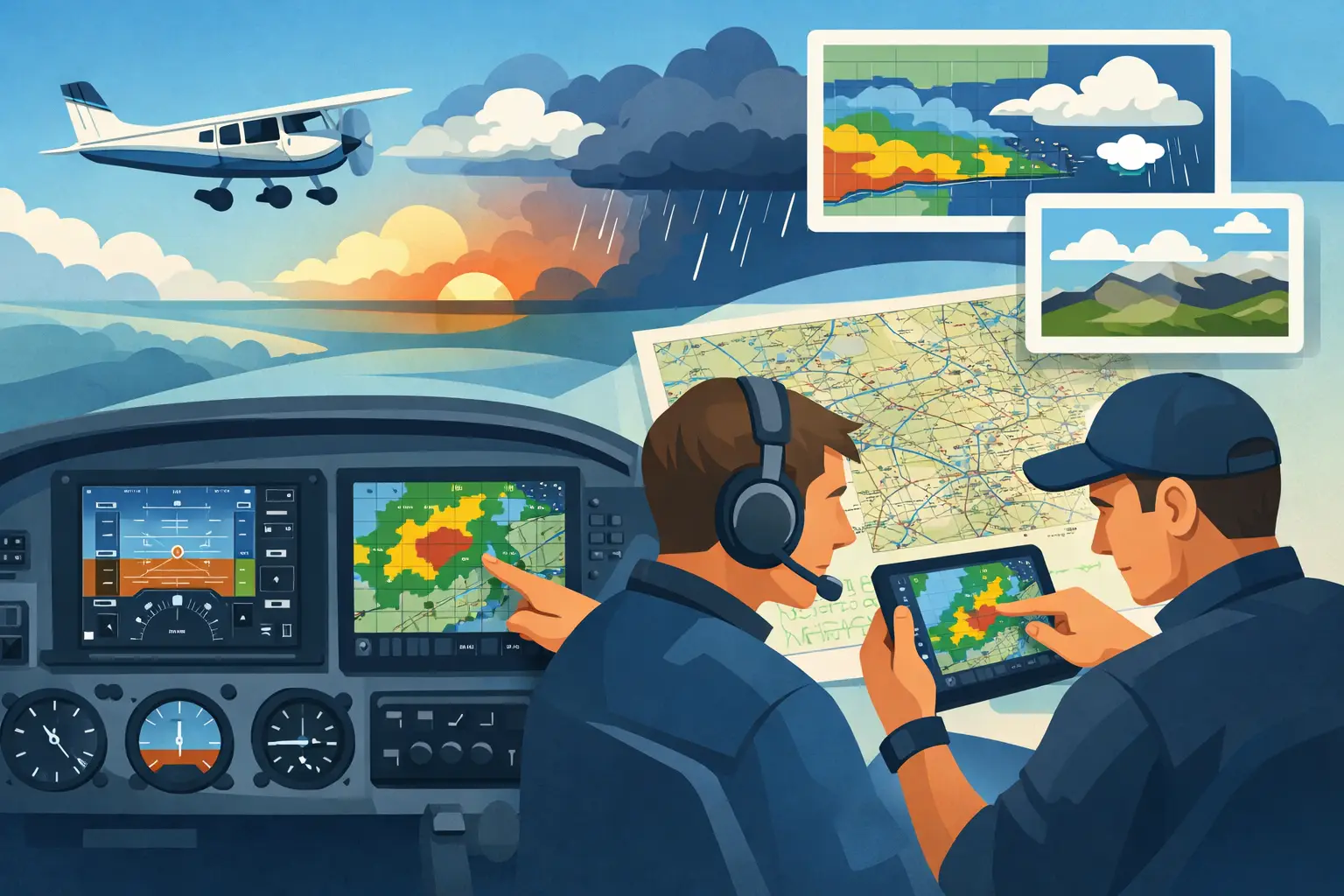
You usually do not feel weather pressure at the airport. You feel it three days earlier, when the hotel is booked, the meeting is on the calendar, and somebody at home asks, "So, are we still going?" That is exactly why learning how to customize pilot weather thresholds matters. If your limits only exist as vague gut feel, every forecast update feels personal.
Most pilots already have personal minimums, at least in principle. The problem is that many of them are too broad to help with a real trip. "No icing" sounds clear until you are looking at a winter route with a shallow layer, tops at 6,000, and a decent out. "Ceilings above 1,000 and three miles" sounds disciplined until that is applied the same way to a familiar daytime leg and a single-pilot night arrival into an unfamiliar airport.
Good thresholds are not about being conservative for the sake of it. They are about being specific enough that the decision gets easier before the pressure builds. When your weather limits match your rating, experience, aircraft, and actual mission, you stop renegotiating with yourself every time the models wobble.
Start with the mission, not the weather
A lot of bad threshold setting starts with a weather product and works backward. That is the wrong order. Start with the flight you are trying to complete.
A 250 nm daytime hop to a familiar airport with plenty of alternates is not the same mission as a 700 nm business trip with a hard arrival time, mountain weather, and a passenger who needs to be back Monday morning. Same pilot, same airplane, very different risk picture. PAVE still works here because the weather question is never just weather. Pilot, Aircraft, enVironment, and External pressures all shape where your threshold should sit.
That means your weather thresholds should be mission-specific. The same pilot might accept marginal VFR on a local reposition but require solid IFR margins, stable winds, and multiple escape options for a family trip. That is not inconsistency. That is judgment.
How to customize pilot weather thresholds in practice
Think in categories, not a single yes-or-no line. Ceiling, visibility, crosswind, convective activity, icing, turbulence, and runway condition each deserve their own threshold. Then add a second layer for context: day versus night, local versus cross-country, known airport versus unfamiliar one, summer pop-ups versus winter systems.
For ceilings and visibility, many pilots make the mistake of choosing numbers that reflect legal capability rather than repeatable comfort. If you are current and proficient in actual IMC, your arrival minimum might be one thing. If you have logged little actual lately and most of your instrument time has been under the hood, it should be another. A 900-foot overcast and two miles may be workable on paper, but the better question is whether it is workable for you, in that airplane, at the end of that flight.
Winds deserve the same honesty. The demonstrated crosswind component in the POH is not your personal limit. It is a data point. If the runway is wide, dry, and familiar, maybe your threshold is one number. If it is narrow, wet, and you have not flown in a month, maybe it is five knots less. If gust spread is large, lower it again. Pilots often underestimate how much the gust factor changes workload on arrival.
Icing is where vague rules get people into trouble. "No known icing" is fine as a baseline if your airplane is not equipped for it, but that still leaves a lot of room for interpretation. Are you avoiding any route with freezing levels below your MEA? Are you comfortable climbing through a thin layer with positive temps above and below? What about descending through a forecast light rime layer near the destination with a strong warm nose below? You do not need a meteorology lecture. You need a line you will actually honor.
Turbulence is similar. Moderate turbulence in a PIREP may be acceptable to one pilot and a hard no to another, especially with family on board or a long leg ahead. Your threshold should reflect not just structural safety but fatigue, workload, and the chance that a manageable first hour becomes an exhausting fourth hour.
Build two sets of minimums
One of the best ways to customize pilot weather thresholds is to separate dispatch minimums from continuation minimums.
Dispatch minimums answer the question, "Should I launch this trip at all?" These should be more conservative because the cheapest and safest off-ramp is before engine start. Continuation minimums answer, "If I am already airborne and the weather is still within this band, am I comfortable continuing, diverting, or waiting it out?" Those numbers can be different because your options, fuel state, and information set change once you are in the system.
This matters most beyond 24 hours, before TAFs exist and before the details settle down. At that stage you are not trying to predict the exact METAR at ETA. You are trying to decide whether the pattern is one you want to bet your trip on. That is where broader thresholds help - not exact winds at 1700Z, but whether the synoptic setup suggests widespread low ceilings, embedded convection, mountain obscuration, or improving conditions behind a frontal passage.
Use recent experience, not your best day
Most pilots set weather limits based on what they once handled successfully, not what they can handle reliably right now. Those are not the same thing.
If you flew a hard IFR trip in busy airspace six months ago and did fine, good. But if your last ten hours have been smooth VMC and one approach to minimums in the sim, your practical threshold today may be higher than your résumé suggests. The reverse is also true. A pilot flying regular actual IMC in a well-equipped airplane may reasonably carry lower ceiling and visibility thresholds than someone with the same certificate who has not seen a cloud in weeks.
This is why threshold customization should be dynamic. Revisit it after a season change, an IPC, a new avionics install, a long break from flying, or a few demanding trips that tell you something useful about your real workload. Personal minimums are not a personality test. They are a current operating spec for one pilot and one airplane.
Match thresholds to the airplane you actually fly
A threshold that makes sense in a known-ice turboprop may be nonsense in a normally aspirated piston single. Even among piston singles, capability varies more than pilots sometimes admit.
A fast airplane can outrun some weather and reach better alternates, but it also stretches legs and can tempt you into pressing on. A turbocharged airplane gives you options with terrain and freezing levels, but only if the oxygen, equipment, and pilot workload picture support it. A basic panel with limited autopilot support changes your fatigue threshold in sustained IMC. TKS changes some icing decisions, but it does not make winter weather simple. Your thresholds should reflect escape options, not just capability in a straight line.
That same thinking applies to route structure. Weather over Kansas is one thing. Weather in the Appalachians, the Sierra, or along a coastal marine layer route is another. Convective thresholds in Florida summer should not look like stratiform winter thresholds in the Midwest.
Treat forecast trend as a threshold input
Pilots often focus on the forecast value and ignore the direction of change. That is a mistake.
A forecast for 1,500 overcast and five miles can mean two different things operationally. If the AFD and model blend suggest improving conditions with rising ceilings and weakening winds, that may fit your trip. If the same numbers sit on the front edge of deterioration, with upstream stations dropping and the discussion hinting at lower confidence, that should tighten your threshold. Stable bad weather is often easier to plan around than weather that is still getting worse.
This is where early decision support earns its keep. Looking three to five days out, the question is less "What will the weather be?" and more "What kind of weather story is developing?" If the route picture is trending toward widespread IFR, embedded convection, or low freezing levels with poor outs, your threshold may tell you to stop making commitments before the last-minute scramble begins.
Write the thresholds down where you can see them
If your minimums live only in your head, they will move under pressure. Put them in writing. Keep them short. Make them operational.
For example, instead of writing "avoid bad convective weather," write something you can apply: no departure if organized convection is forecast within the route window unless there is a clear, fuel-practical deviation strategy and multiple alternates. Instead of "watch icing," write the altitude, temperature, and route conditions that make it a no-go for you.
The point is not to create a legal document. The point is to reduce bargaining. When the bags are packed and somebody is asking for an answer, a written threshold protects you from your most persuasive passenger - yourself.
For pilots using PlaneWX, this is exactly where a personalized WX Score becomes useful. Not as a substitute for your weather judgment, but as a way to express your real thresholds against the route, the timing, and the evolving forecast pattern before TAF range. The more honestly you set those thresholds, the more useful the output becomes.
A good weather threshold does not promise you will always go. It gives you something better: the confidence to go, or the courage to stay. If your current minimums feel fuzzy, spend an hour this week tightening them up before the next trip asks the question for you.