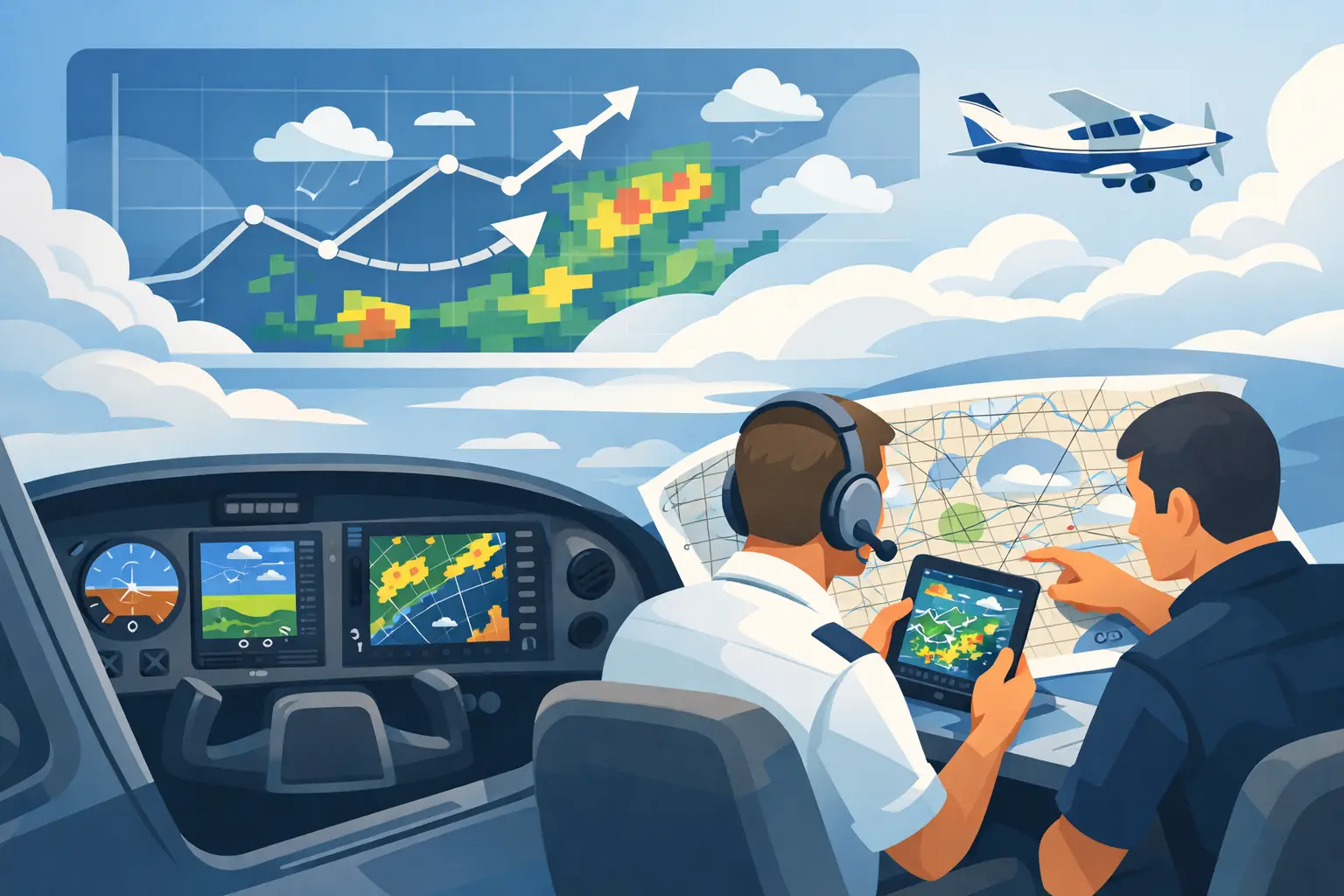
You usually do not feel weather pressure at engine start. You feel it three days earlier, when the hotel is booked, the meeting is on the calendar, and somebody at home asks, "So, are we flying Friday or not?" That is where weather trend analysis in aviation matters most - not as an academic exercise, but as a way to see whether a trip is starting to come together or starting to unravel.
Most pilot tools are very good once the short-range picture tightens up. METARs tell you what happened. TAFs tell you what the airport is expected to do. Radar, satellite, SIGMETs, AIRMETs, and PIREPs help once the event is close enough to observe directly. But the real planning stress often shows up before any of that gives you a clean answer. If you are trying to decide on a business trip four days out, the question is rarely, "What will the ceiling be at 1900Z?" It is, "Is this pattern trending toward a workable IFR trip, or am I setting myself up for a bad call later?"
What weather trend analysis in aviation actually means
In practical flying, trend analysis is not about predicting an exact weather outcome at one airport. It is about following the structure of the atmosphere over time and asking whether the ingredients for your flight are improving, holding, or deteriorating.
That sounds simple, but it changes the whole planning mindset. A pilot looking only at snapshots can get whipsawed by every model run. A pilot looking at trends starts to notice the things that matter more: the timing of a front, whether moisture return is overperforming, whether instability is showing up earlier each run, whether low stratus behind a system is sticking around longer than expected, whether winds aloft are lining up to make mountain wave or icing more likely.
For a real trip, those trend questions matter more than the false precision of a single forecast image. They help you judge whether your mission is moving toward green, drifting toward yellow, or quietly becoming red while the calendar pressure keeps building.
Why trend analysis matters before the TAF window
The gap beyond 24 hours is where many go-no-go decisions are emotionally hardest. You do not yet have airport-specific forecast detail, but you may already need to commit to passengers, hotels, rental cars, and business meetings. This is also where pilots are most tempted to fill in the blanks with optimism.
I have done it myself. You look at a distant system and think, maybe it will speed up. Maybe the ceilings will lift. Maybe the convection will stay south. Sometimes it does. But hope is not a planning method.
Good weather trend analysis in aviation gives you a way to replace hope with probability. Not certainty - probability. That distinction matters. If a route has been trending worse for three forecast cycles, AFD language is growing more concerned, NBM probabilities are slipping, and the synoptic setup supports widespread low ceilings, you are not being pessimistic by taking that seriously. You are being honest about the direction of the risk.
The opposite is also true. Sometimes the broad pattern is improving even when the details are still messy. A departing trough, drying air, rising pressure, and improving ceiling probabilities can tell you a lot before the local TAF fully catches up. That is the kind of signal that helps a pilot hold a trip together with clear eyes instead of canceling too early.
The inputs that actually move the needle
Trend analysis works best when you stop treating every weather product as equal. Some products tell you what is happening now. Some tell you what forecasters are worried about. Some show how uncertainty is changing. Put together, they tell a much more useful story than any one chart alone.
TAFs and METARs still matter, but they are late-stage tools in this context. If you are three to five days out, Area Forecast Discussions often tell you more. AFDs are where forecast offices show their reasoning, confidence, and concerns. You can see when one office is worried about fog and another is focused on convective timing. Along a long route, that matters. The destination may look fine while the middle third of the trip is starting to go sideways.
This is where synoptic context matters more than airport weather. A cold front crossing your route is not just a line on a chart. It is timing uncertainty, possible convection, shifting freezing levels, post-frontal ceilings, and wind changes that may affect alternates as much as your destination.
Probabilistic data also matters more than many pilots give it credit for. NBM guidance can help you stop arguing with a single deterministic outcome and start asking better questions. What is the chance ceilings drop below your personal minimums? What is the probability of IFR at the destination during your arrival window? Is that probability getting better or worse with each update?
High-resolution models like HRRR become useful later, closer to departure, especially for timing details. But if you lean on them too early, they can create a false sense of precision. Early on, broad pattern recognition and probabilistic trend direction usually beat detailed tactical guessing.
PIREPs, SIGMETs, and AIRMETs enter the picture as the flight gets closer and the atmosphere starts proving what the forecast only suggested. They are confirmation tools. They help you validate whether the trend you were tracking is actually materializing.
Trend analysis is really about decision pressure
Most weather mistakes in GA are not knowledge problems. They are judgment problems under pressure. The weather is rarely the only factor in the cockpit or in your head. PAVE exists for a reason. The "E" is often doing more work than pilots want to admit.
External pressure gets stronger the longer you wait to make a hard call. If your first honest look at the trip happens the night before, you are already behind. Now you are tired, invested, and tempted to negotiate with your own minimums. That is how pilots start saying things like, "I will launch and take a look," when the pattern had been warning them for two days.
Weather trend analysis creates distance from that trap. It gives you a longer runway for decision-making. Instead of one dramatic yes-or-no moment, you get a series of smaller, calmer judgments. The route is improving. The route is holding. The route is slipping. That may be enough to move the meeting, delay a hotel, brief the family, or line up an airline backup before the pressure peaks.
That earlier clarity is not about making every trip happen. Sometimes the best outcome is seeing a likely no-go early enough that staying home feels deliberate instead of disappointing.
A practical way to evaluate a trip
When I look at a trip a few days out, I do not start with airport minutiae. I start with the route and the pattern. Is there a stable setup with only local morning stratus to sort out, or is there a broad, messy system affecting multiple weather offices with timing uncertainty baked in?
Then I look for agreement or disagreement across sources. If the AFDs along the route are converging on the same concern, that gets my attention. If the NBM probabilities are moving in the wrong direction across successive updates, that matters. If one deterministic model says the weather will clear in time but the broader pattern still supports widespread low ceilings, I trust the pattern more.
After that, I bring it back to the actual mission. Not some generic pilot. Me, this airplane, this route, this departure time, this alternate plan. A 1,500-foot overcast at the destination may be fine for one pilot and a trip-killer for another depending on terrain, fuel options, icing risk, and what the return leg looks like. Trend analysis only becomes useful when it is filtered through real personal minimums.
That is the core idea behind a tool like PlaneWX. It is built for the period before TAFs exist, when pilots still need to decide whether to commit. By synthesizing AFDs across the route, calibrating that against NBM probabilistic data, and expressing the result as a personalized WX Score, it gives you a practical sense of whether the trip is becoming more viable or less viable as departure approaches.
That does not replace your judgment. It supports it. And that is exactly the point.
The trade-off pilots need to accept
Trend analysis will never remove uncertainty. If anything, it makes uncertainty more visible. Some pilots find that uncomfortable because it does not hand over a neat answer. But flying real trips in GA has always involved uncertainty. The better question is whether you want to face that uncertainty early, while you still have options, or late, when your choices are worse.
A good trend read can still be wrong. Systems speed up. Convection underperforms. Fog hangs in longer than expected. That is part of the job. But the goal is not perfection. The goal is better timing, better judgment, and fewer flights where you realize too late that the signs were there all along.
If you have a trip on the calendar this week, start watching the pattern now. Not just the forecast, the trend. Ask whether the route is getting better, worse, or less certain. Then make decisions while you still have room to make them. That is how you earn the confidence to go, or the courage to stay.