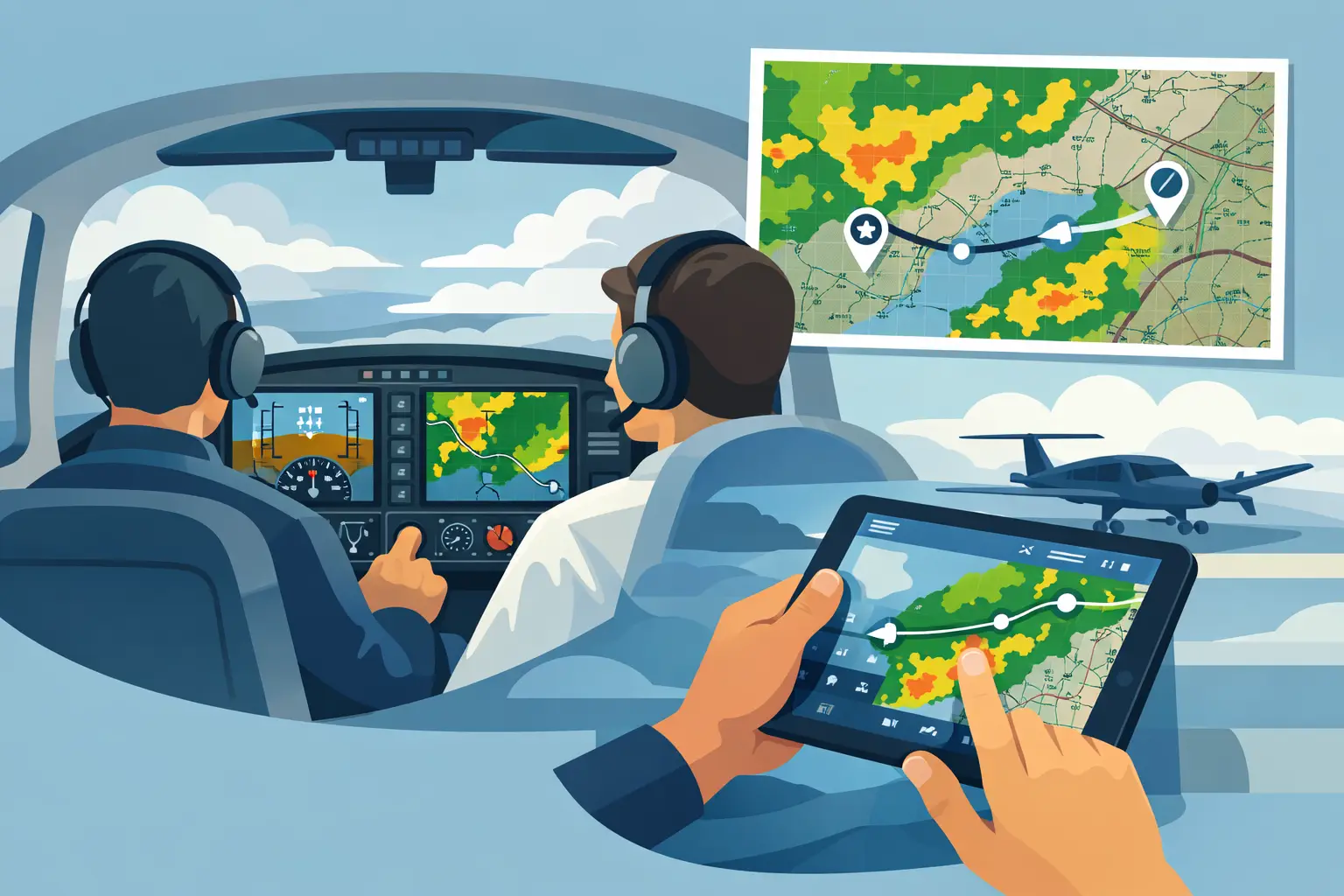
You usually don’t feel the pressure when you file. You feel it two or three days earlier, when the hotel is booked, the meeting is on the calendar, and your family asks, "So are we flying or driving?" That’s where an IFR weather decision tool earns its keep - not at the last minute, but in that awkward window before TAFs exist and before the picture is clean.
Most of us already have solid cockpit weather habits. We check METARs, read the TAFs, scan PIREPs, and keep an eye on AIRMETs and SIGMETs. The problem is that none of those tools really answers the question you need answered on Tuesday for a Friday departure: is this trip shaping up to be workable for me, in this airplane, on this route?
That’s a different problem than basic weather briefing. It’s a decision problem.
What an IFR weather decision tool should actually do
A useful IFR weather decision tool should help you make an earlier, calmer go/no-go call without pretending it knows the future. If it just dumps model data in your lap, it hasn’t solved much. You still have to stitch together the big picture, weigh uncertainty, and translate a forecast into operational risk.
For real-world IFR flying, the job is bigger than spotting a low ceiling at the destination. You need to understand the pattern along the route, the timing of deterioration or improvement, the odds that ceilings and visibility will fit your personal minimums, and whether the trip still works if one leg goes sideways. That means the tool has to think in probabilities, trends, and route-level context.
It also has to respect that IFR capable does not mean all-weather capable. A pilot in a normally aspirated piston single has a different answer than a pilot in a FIKI-equipped turboprop, even on the same day and route. A real decision tool has to account for pilot, aircraft, environment, and mission - the same PAVE framework we all know, just applied before the pressure peaks.
Why the hardest weather decisions happen before the forecast gets good
The frustrating part of trip planning is that your commitment deadline usually arrives before the best forecast products do. By the time you have a tight TAF-driven picture, you may already have told your client you’re coming, rearranged the family schedule, or committed to a fuel stop and overnight.
That’s where pilots get trapped. Not because they can’t read weather, but because they’re being forced to make a soft commitment with weak information. Then, when the weather turns marginal, external pressure is already in the cockpit.
If you’ve flown enough real trips, you know this feeling. Thursday’s system looked manageable on Monday. By Wednesday evening the frontal timing has shifted six hours, the freezing level is not where you hoped, and now you’re trying to decide whether the trip is still smart or whether you’re just trying to rescue the plan.
An IFR weather decision tool is most valuable in that earlier window. Not because it can predict every detail, but because it can show whether the pattern is generally improving, deteriorating, or staying unstable. That lets you make better decisions before the scramble starts.
The difference between data and decision support
A lot of pilots already have access to weather data. What they don’t have is synthesis.
If you’re flying a multistate route, the weather story may span several forecast areas and multiple NOAA Weather Forecast Offices. The AFDs often contain the real reasoning - what the forecaster thinks is driving uncertainty, where timing could slip, which layer may be stubborn, whether convection is likely to overperform or underperform guidance. That nuance matters a lot more than a single model snapshot.
The catch is that reading one AFD is easy. Reading ten or twenty for a route, then reconciling them with NBM probabilities, current trends, and your actual trip constraints, is work. Good decision support condenses that workload without hiding the why.
That’s the gap PlaneWX was built to fill. It uses Synoptic Intelligence™ to synthesize AFDs from up to 122 Weather Forecast Offices along your route, calibrates that narrative against NOAA probabilistic guidance like the NBM, and turns it into a personalized WX Score - a 0 to 100 percent probability that your specific flight is viable based on your ratings, experience, personal minimums, and aircraft capabilities. That’s not a replacement for your EFB. It’s the part you’ve probably been doing in your head, too late and with too little time.
What to look for in an IFR weather decision tool
First, it should be route-aware, not airport-only. IFR trips fail in the middle all the time. The departure and destination can look fine while the route itself is the problem - embedded convection, mountain obscuration, icing in the altitude band you actually need, or a long stretch with poor outs.
Second, it should handle uncertainty honestly. Weather three to five days out is not about certainty. It’s about narrowing the range of likely outcomes and showing whether the risk is stacking up or backing off. If a tool acts overly precise at that range, be suspicious.
Third, it should be personal. A forecast that is acceptable for one pilot may be a hard no for another. Recent actual IMC time, alternate options, terrain familiarity, oxygen capability, onboard equipment, and ice protection all matter. If the tool gives the same answer to everybody, it’s not really supporting a decision.
Fourth, it should refresh as the departure gets closer. Early visibility is useful, but the real value comes when the picture updates automatically and tightens as TAFs, METAR trends, HRRR runs, PIREPs, and short-term guidance start to sharpen the story.
Where pilots still need judgment
No tool gets you off the hook as PIC. That’s not a disclaimer. It’s just reality.
Some trips are obvious no-gos. Others are obvious yeses. The tough ones live in the middle, where the data says probably workable, but only if the timing holds, the alternate stays above your comfort line, and the convective line doesn’t get ahead of schedule. That’s where pilot judgment still matters most.
A good IFR weather decision tool helps by making the uncertainty visible sooner. Maybe the signal says the route has been trending worse for three forecast cycles. Maybe the westbound leg still looks fine but the return is degrading. Maybe the destination is likely okay but the morning departure window is shrinking. Those are useful truths even when they don’t produce a simple answer.
That also means there will be days when the smartest use of the tool is to cancel early. Not because the weather is impossible, but because the probability of a clean, low-stress trip is dropping below what makes sense for your mission. There’s real value in making that call on Wednesday instead of wrestling with it in the hangar on Friday morning.
The real payoff is lower pressure
The best part of better weather decision support is not convenience. It’s emotional margin.
When you can see a trip’s viability taking shape earlier, you can start making adult decisions before the pressure locks in. You can move the meeting, drive one leg, leave a day earlier, book a backup airline seat, or tell the family the plan is still tentative. That changes the whole tone of the trip.
Pilots sometimes think weather tools are about precision. In practice, they’re often about reducing pressure. The earlier you can identify a weak weather setup, the less likely you are to talk yourself into a marginal launch just because too many things are already in motion.
That’s why the right tool matters most for serious personal and business travel. Not to make you bolder, and not to make you timid. Just to give you a clearer read on whether this mission is coming together or coming apart.
If you’re already comfortable reading the usual products but still find yourself wishing you had better insight three or five days ahead, that’s exactly the problem an IFR weather decision tool should solve. If you want to see how PlaneWX approaches that window beyond 24 hours, you can take a look at https://www.planewx.ai. Better calls start earlier, and sometimes the best outcome is simply having the confidence to go, or the courage to stay™.