
Find the right U.S. airport of entry with GA Customs
Before you cross the border, use the GA Customs airport-of-entry finder to compare airports, hours, fees, and arrival details. Download GA Customs on the App Store so the information is ready before departure.
The flight is nearly over, the family is ready to be on the ground, and the weather at your first U.S. stop has started to slide. That is a poor moment to learn that U.S. airports of entry for GA are not interchangeable. Customs availability, required notice, airport status, and an arriving front can turn a routine border crossing into the most demanding leg of the trip.
For a cross-border GA mission, the airport where you clear Customs and Border Protection is part of the route, not an administrative detail. Treat it with the same attention you give fuel reserves, alternates, and a deteriorating ceiling.
Check airport details before departure
!Map view of U.S. airports of entry
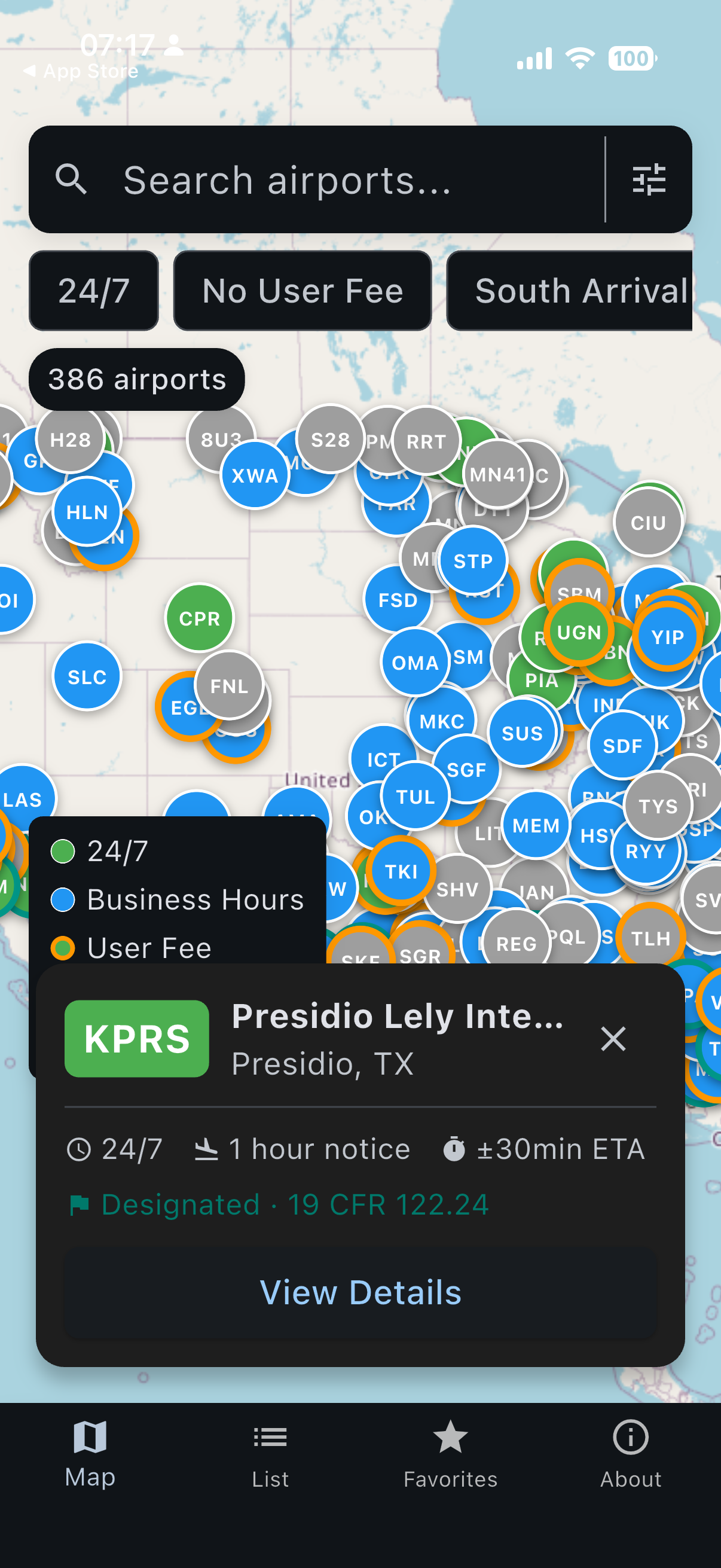
Map view of nearby airports of entry.
!Airport hours and requirements
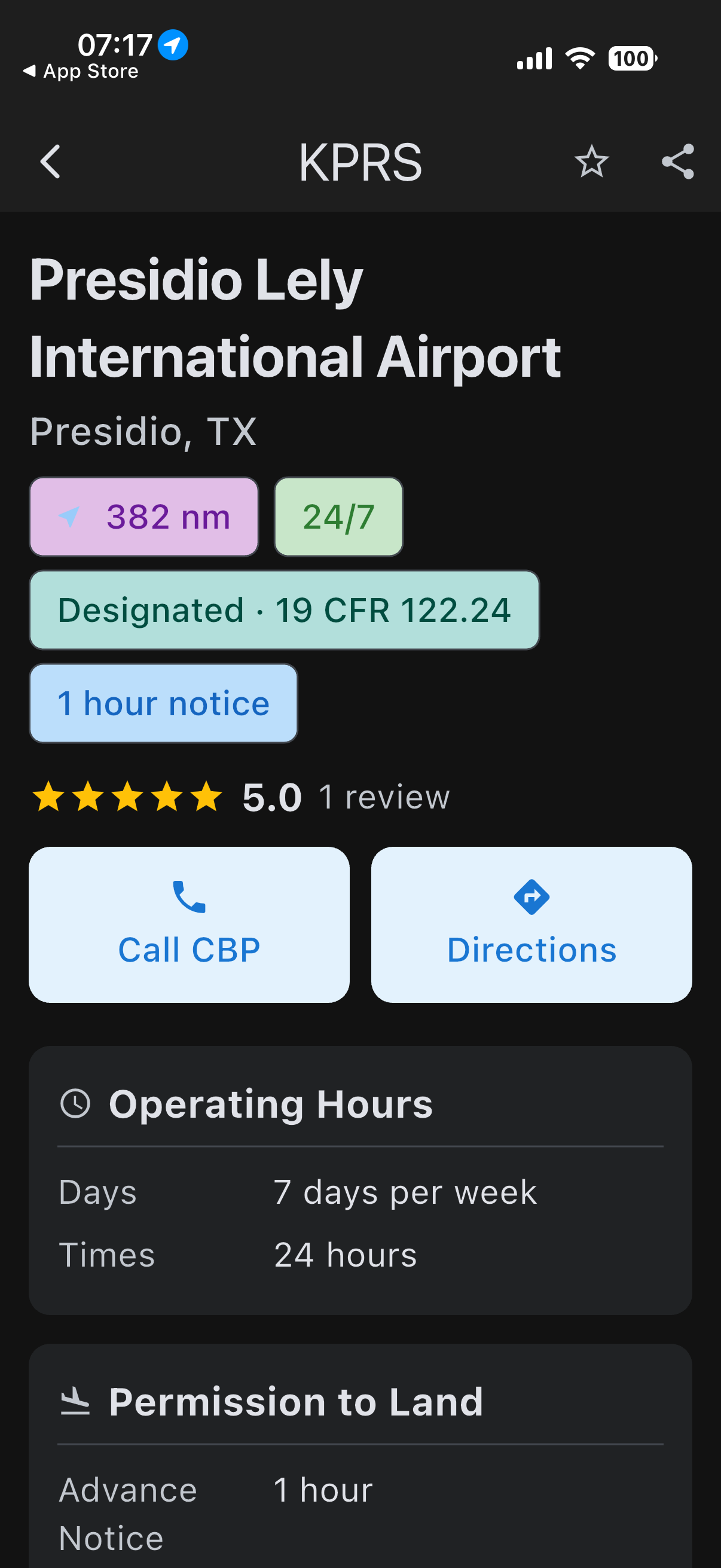
Airport hours and advance-notice details.
!Customs arrival process and reviews
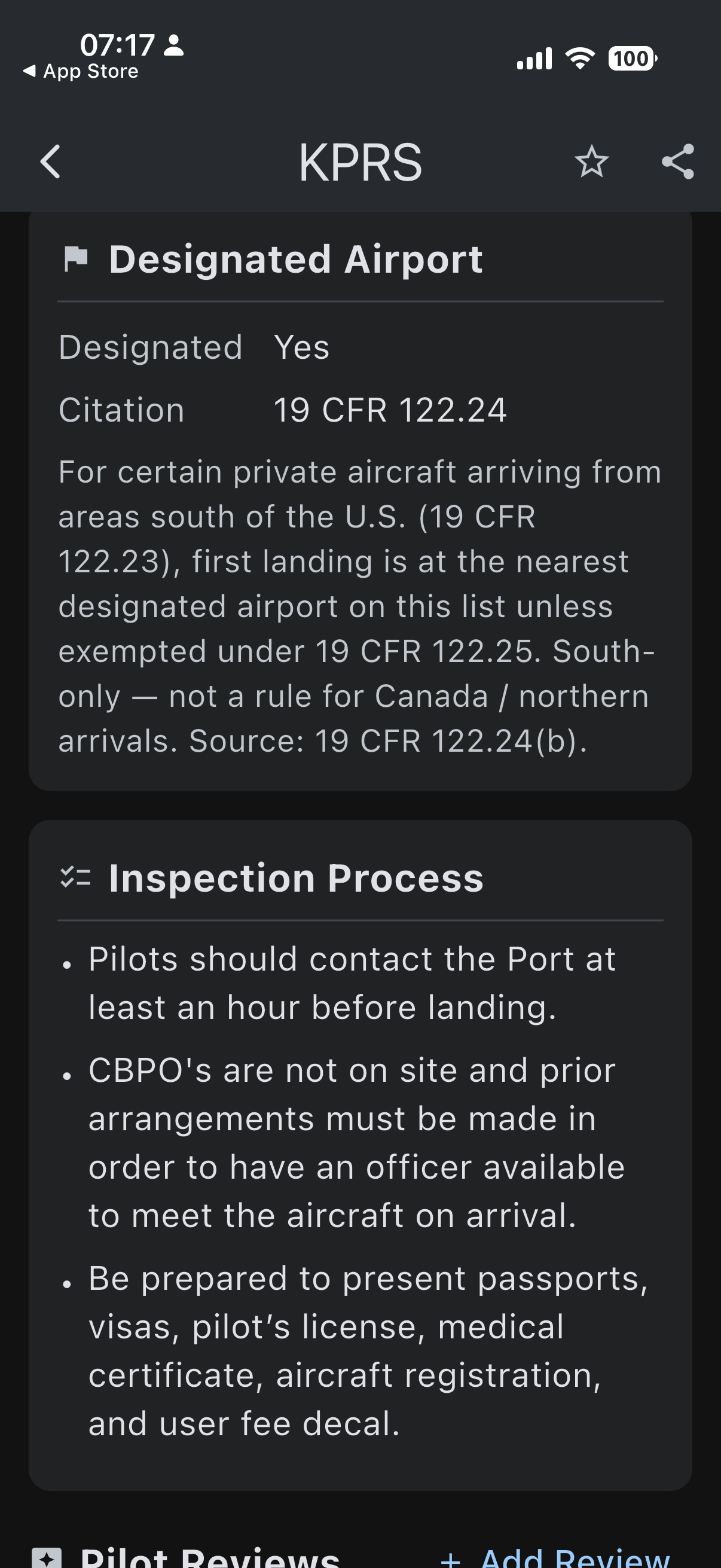
Arrival process details and pilot reviews.
What counts as a U.S. airport of entry for GA?
The shorthand can be misleading. An airport may have a CBP presence, but that does not necessarily mean it is available for your arrival at the time you need it or under the process you expect.
An airport of entry is designated to process international arrivals. A user fee airport may provide CBP service under a reimbursable arrangement, generally with prior coordination. A landing rights airport may require specific advance permission before arrival. The practical point is simple: do not build a plan around an airport based on a chart label or a prior pilot report alone.
Before departure, confirm that your chosen airport can accept your aircraft, from your point of departure, at your planned arrival time. Ask the local CBP office about its hours, notice requirements, appointment process, and any overtime or after-hours limitations. A FBO may be helpful, but CBP is the authority that matters.
Your eAPIS submission is also its own task. Complete the required manifest and confirmations within the applicable timeline, but do not assume the electronic process replaces a call or other local coordination. Those are separate failure points, and either one can spoil an otherwise well-planned arrival.
Pick an arrival airport with operational margin
The closest airport is not always the best first U.S. landing point. For many piston singles, the right choice is the airport that gives you fuel flexibility, an instrument approach you are comfortable flying, a usable runway in the forecast wind, and a realistic place to wait if weather or CBP timing changes.
That calculation changes with the mission. A direct flight from the Bahamas to Florida may offer several practical options, while a return from Canada across a frontal boundary can make the nearest port of entry a poor bet. If the destination forecast is marginal and the next acceptable customs airport is far away, the fuel decision needs to be made before crossing the border, not while you are descending through a broken layer.
Build a primary arrival airport and a backup that you have actually vetted. Keep the appropriate CBP contact information readily available, along with the FBO number, hours, fuel availability, and your updated ETA. If a diversion becomes necessary, communicate with CBP as soon as safety and workload permit. Do not assume a weather-driven change is self-explanatory to the people expecting you at another airport.
Weather can make customs timing unforgiving
Customs appointments create a time constraint that ordinary domestic flying does not. You may have a valid instrument rating, a capable airplane, and a legal approach, yet still decide the weather margin is too thin when a missed approach, hold, or reroute could put you outside the window you arranged.
This is where the forecast trend matters more than the single forecast line. A TAF and METAR tell you what is expected near the airport, while PIREPs, SIGMETs, AIRMETs, and the broader synoptic setup tell you whether the day is becoming more workable or less forgiving. Read the AFDs along the route and at both your primary and backup ports of entry. They often reveal the timing uncertainty behind a forecast that looks deceptively tidy.
For trips planned several days out, the commitment problem arrives before the TAF does. Hotels get booked, passengers arrange time off, and a return date starts to feel fixed. PlaneWX uses Synoptic Intelligence™ and NBM probability data to help you see that developing pattern earlier, then refreshes the picture as the trip gets closer. It will not remove the need to coordinate with CBP, but it can help you avoid choosing a customs airport around a weather plan that is already weakening.
Make the arrival brief a deliberate stop
Before the border crossing, pause and brief the arrival as a distinct phase of flight. Confirm the airport, your ETA, fuel remaining, runway and approach plan, weather trend, customs procedure, and backup option. Recheck that the people on board understand that clearing customs may involve waiting in the aircraft or following specific instructions after shutdown.
Use PAVE honestly. Pilot and aircraft capability matter, but so do external pressures. The dinner reservation, a business meeting, or a family waiting at the terminal are not reasons to press into a closing weather window at a time-sensitive port of entry. They are reasons to preserve more margin.
On your next international trip, make the CBP call and select the backup airport while the forecast is still favorable. For the airport details, review GA Customs and get the app on the App Store. That small bit of discipline buys the confidence to go, or the courage to stay™.