

Last reviewed: October 1, 2026. Requirements on this page are from U.S. Customs and Border Protection (CBP) pages updated in late September 2026, 19 CFR Part 122 as current on eCFR, the FAA Aeronautical Information Manual and the September 3, 2026 FAA Chart Supplement. CBP procedures change, so confirm every arrival with CBP and the airport before you fly. Sources are listed at the end.
To find a U.S. customs airport for a general aviation flight, start with CBP’s General Aviation Airports list, which shows the airports where CBP inspection is normally available for GA arrivals, then open that airport’s CBP fact sheet for its hours, phone numbers and permission to land procedure. [1][2] Your first landing must be at an international airport, a landing rights airport or a user fee airport. [3] If you are arriving from the south and do not hold an overflight exemption, it must be the nearest designated airport to where you cross the border or coastline. [4] Transmit your eAPIS manifest no later than 60 minutes before you depart the foreign airport, then call the CBP port and get permission to land before you take off. [5][6] GA Customs, a free iPhone and iPad app from PlaneWX, puts those airports, their hours, fees and notice rules on one map. GA Customs does not file eAPIS. You, or a party you authorize, transmit the manifest through CBP’s official eAPIS site at eapis.cbp.dhs.gov or another CBP-approved system. [5][7] CBP still grants the arrival, and you still make every call as pilot in command.
The short answer: how to clear customs flying a private plane into the U.S.
- Pick an airport you are allowed to land at first. That means an international airport, a landing rights airport or a user fee airport. Coming from the south without an overflight exemption, it means the nearest designated airport to your crossing point. [3][4]
- Check that CBP actually serves it for GA, and when. Use the CBP General Aviation Airports list and the airport’s fact sheet. The hours of service for entrance and clearance are the hours that matter, not just the office hours. [1][7]
- Buy or renew the Private Aircraft User Fee decal. CBP sells it online through DTOPS, and you need a current one for inbound flights. [7]
- Transmit the arrival manifest in eAPIS. CBP’s official eAPIS site is eapis.cbp.dhs.gov. The deadline is no later than 60 minutes before departure from the foreign port or place. [5][7]
- Call the CBP port and secure permission to land before you depart the foreign airport. CBP requires this direct contact at every airport. [6]
- Land where your APIS says, unless CBP tells you otherwise or the FAA changes it for safety. [3]
- Going back out? The departure manifest is due no later than 60 minutes before you depart the United States, and private aircraft normally receive clearance by email after APIS processing. [5][7]
Which U.S. airports can a private plane clear customs at?
Pilots often say “airport of entry” for any airport where CBP will clear a GA flight. The regulations use four more specific labels, and the difference decides what you have to arrange before you go.
International airports
An international airport is designated as a port of entry for aircraft, for people and for quarantine inspection, and 19 CFR 122.13 lists them. [8][9] The rule on cost is plain: “International airports are open to all aircraft for entry and clearance at no charge by Customs.” The airport itself can still charge you. [9] You still need an eAPIS manifest and permission to land from the port. [6] 19 CFR 122.12 says permission to land at an international airport will be denied to a private aircraft that fails to submit the electronic manifest and notice of arrival, except in an emergency or forced landing. [9]
Landing rights airports
A landing rights airport is “any airport, other than an international airport or user fee airport, at which flights from a foreign area are given permission by Customs to land.” [8] For a private aircraft, the pilot secures permission to land from CBP after the advance notice of arrival, and must receive a message from CBP that landing rights have been granted before departing the foreign airport. [9] The FAA glossary describes it the same way: “A landing rights airport at which specific permission to land must be obtained from customs authorities in advance of contemplated use.” [10] CBP can deny or withdraw landing rights, for example when enough federal personnel are not available. [9]
User fee airports
A user fee airport is designated by CBP, and flights from a foreign area “may be granted permission to land at a user fee airport rather than at an international airport or a landing rights airport.” [8] Permission to land works the same way as at a landing rights airport. [9] The designation depends on money owed to CBP being paid on time, and 19 CFR 122.15 withdraws it if amounts due to Customs are not paid. [9] Those costs often reach the pilot: the Chart Supplement legend warns that “Private Aircraft operators are frequently required to pay the costs associated with customs processing.” [11] Fees are set locally, so ask the airport. The regulation itself says the list in 19 CFR 122.15 “is subject to change without notice” and that “Information concerning service at any user fee airport can be obtained by calling the airport or its authority directly.” [9]
Designated airports (arrivals from the south)
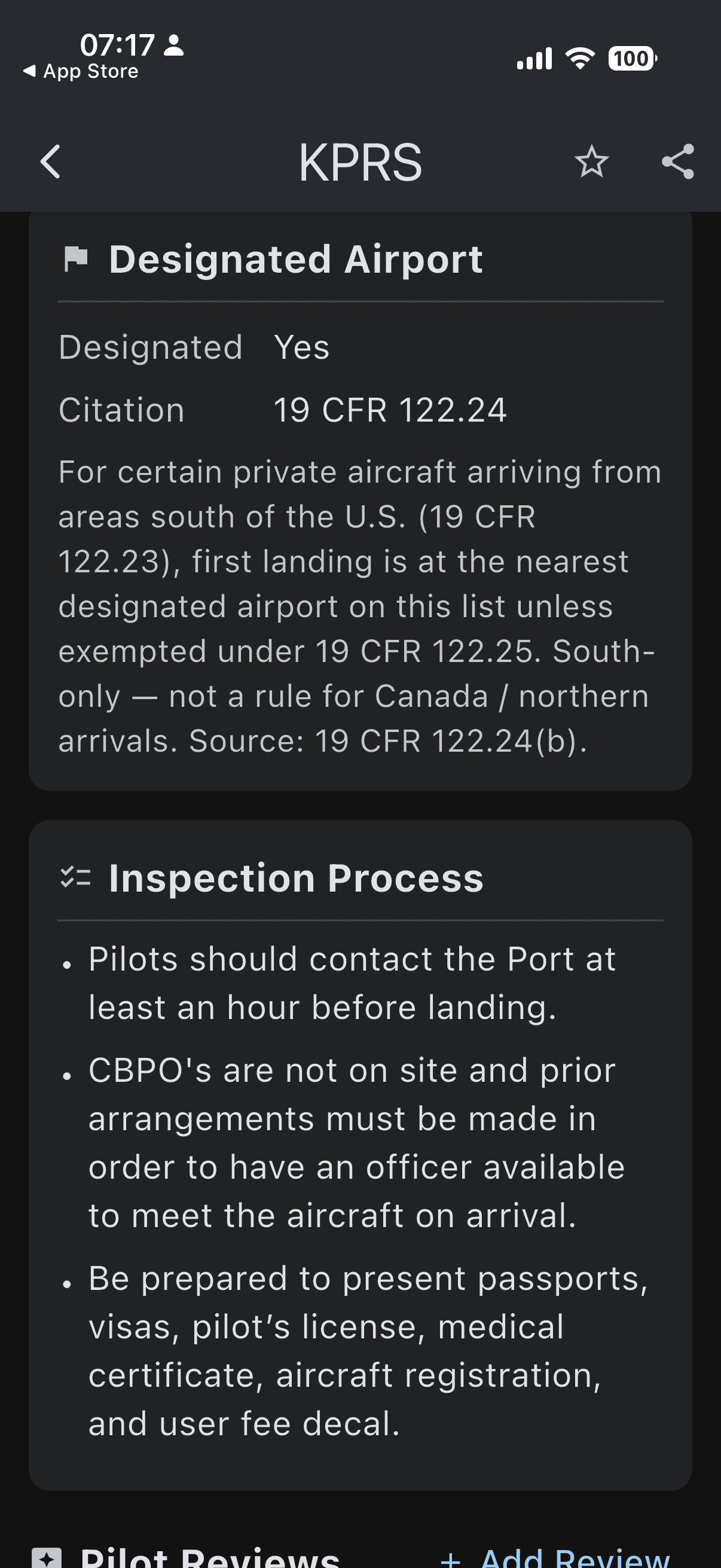
Designated airports are the airports listed in 19 CFR 122.24(b). They matter only when 19 CFR 122.23 applies to your flight, which is covered below. [4][12] Landing at a designated airport does not replace the other rules. 19 CFR 122.24(a) says these pilots “must comply with all other landing and notice of arrival requirements.” [4] Fort Lauderdale Executive, for example, is on the 122.24 list, and its Chart Supplement entry carries the LRA (landing rights airport) label. [4][11]
The CBP General Aviation Airports list
CBP keeps a list of airports where its inspection services are normally available for GA arrivals, by ICAO code, with a column showing which airports have a USDA compliance agreement for international garbage. [1] The version dated September 25, 2026 has 382 airports in its CSV download (our count, October 1, 2026). [1] CBP does not repeat the international and designated airport lists there, because those are in 19 CFR 122. [1] Being on the list does not replace the call. For arrivals at every airport on it, CBP says operators must contact the CBP airport of arrival to secure permission to land. [1]
How to tell from the chart whether an airport is an airport of entry
The FAA Chart Supplement marks customs airports near the start of each airport entry, after the elevation. The legend item is titled Airport of Entry, Landing Rights, and Customs User Fee Airports, and it uses AOE for airport of entry and LRA for landing rights airport. [11] The Fort Lauderdale Executive (KFXE) entry in the September 3, 2026 Southeast volume, for example, shows LRA, and its airport remarks give the hours U.S. customs is available and where the customs ramp is. [11] The FAA glossary definition of international airport includes both: an airport of entry designated for customs service, and a landing rights airport. [10]
Read the AOE legend line with care. It still says AOE means “A customs Airport of Entry where permission from U.S. Customs is not required to land.” [11] CBP’s current General Aviation page is stricter, and CBP is the authority: “For ALL international arrivals at ALL airports, pilots MUST contact the responsible CBP port of arrival directly to secure permission to land.” [6] Treat the chart label as a way to spot candidate airports, then follow CBP’s procedure. The AIM points the same way: complying with CBP requirements, including APIS under 19 CFR Part 122, is one of the conditions for civil aircraft operating to or from U.S. territorial airspace. [13] Your EFB’s airport information may show airport of entry status too. Treat it the same way.
Coming from the south: designated airports and overflight exemptions
19 CFR 122.23 applies to most private and charter aircraft arriving in the continental United States across the Mexican border or Pacific coast from a place in the Western Hemisphere south of 33 degrees north latitude, across the Gulf of Mexico and Atlantic coasts from a place south of 30 degrees north latitude, or from anywhere in Mexico, the U.S. Virgin Islands or Puerto Rico. [12] Those aircraft “must land for CBP processing at the nearest designated airport to the border or coastline crossing point” unless they hold an overflight exemption. [4] 19 CFR 122.24(a) lists exceptions, such as aircraft precleared by CBP. [4]
An overflight exemption, which CBP calls a Border Overflight Exemption (BOE), lets an approved aircraft fly past the designated airports to an approved airport farther in. CBP takes BOE applications through eAPIS, and Form 442 is no longer used. [6] CBP says processing “will take no more than thirty (30) days and there is no charge or fee associated with the process,” and new or renewed exemptions approved since September 19, 2024 are valid for 3 years. [7] An exemption does not remove the rest of the process: “Aircraft traveling under an exemption shall continue to follow advance notice and general landing rights requirements.” [14]
Coming from Canada is simpler. CBP’s answer to whether you need an overflight exemption from Canada is no: “Arrivals at the first port of entry and Overflight Exemptions are not required for flights arriving in the United States from Canada.” [7] You still land at an international, landing rights or user fee airport, file eAPIS and get permission to land. [3][6]
eAPIS timing and permission to land
APIS is the requirement and eAPIS is CBP’s web portal for meeting it. CBP notes that not everyone uses eAPIS to transmit the manifest. [7] CBP’s official eAPIS link is eapis.cbp.dhs.gov. [7] GA Customs does not file eAPIS. You, or a party you authorize, transmit the manifest to CBP. [5] For an arrival, the manifest and notice of arrival are due “no later than 60 minutes prior to departure of the aircraft from the foreign port or place.” [5] For a departure from the United States, the manifest is due “no later than 60 minutes prior to departing the United States.” [5] The pilot is responsible for the accuracy and timeliness of the data, even when someone else submits it. [5]
The manifest alone does not get you in. In CBP’s words: “After transmitting an APIS manifest, you need explicit permission to land from the port of arrival. You’ll need to call and get that from them before departing from the foreign area.” [7] If the tail number changes, or a traveler is added or substituted, you transmit an amended manifest and reconfirm permission to land. [6][15] Changes to ETA or arrival airport must be coordinated with CBP at the new arrival location. [5] Then land at the airport named in your APIS transmission unless CBP instructs otherwise or the FAA changes it for safety. [3]
Hours, overtime and fees
Each CBP fact sheet lists two sets of hours: regular office hours, when the CBP office is staffed, and hours of service for entrance and clearance, the days and times GA inspection is available. It also gives phone numbers, the permission to land procedure with ETA tolerances, and the inspection process. [2][7] Plan your arrival inside the hours of service, with room for a late departure or a headwind.
Arriving after hours, which pilots often call an overtime arrival, is not something to assume. Many operators and service providers take part in CBP’s Reimbursable Services Program, which CBP describes as “facilitating off-hours arrivals.” [7] At a location outside the limits of a port of entry, the operator pays any added inspection charges when landing rights are given. [9] Ask the port and the airport whether service outside the published hours is possible and what it costs.
Two fees are easy to mix up:
- The Private Aircraft User Fee decal is an annual CBP fee bought on DTOPS. CBP’s FAQ, updated September 30, 2026, says: “The current cost for a Private User Fee Decal is $38.04 (effective October 1, 2026).” CBP adds that the cost typically rises each October 1. [7] If you arrive without a valid decal or proof of a recent purchase, you will have to buy one before CBP releases you from inspection. [7]
- User fee airport charges are separate and set at the airport. International airports clear you at no charge by Customs, though the airport may charge its own fees. [9]
Requirements change: verify with CBP and the airport
CBP is open about how fast local procedures move. When a CBP officer’s information conflicts with a fact sheet, CBP explains that port management sometimes changes hours, contacts or procedures, and “These changes are not always communicated timely to CBP Headquarters.” [7] CBP also says the old U.S. Customs Guide for Private Flyers “has not been a valid document for over fifteen years.” [7] So any list, app, guide or page, including this one, is a starting point. The phone call to the CBP port, and the airport for user fee details, is the check that counts. For general questions, CBP’s General Aviation office is at GAsupport@cbp.dhs.gov. [6]
How GA Customs helps you plan the arrival
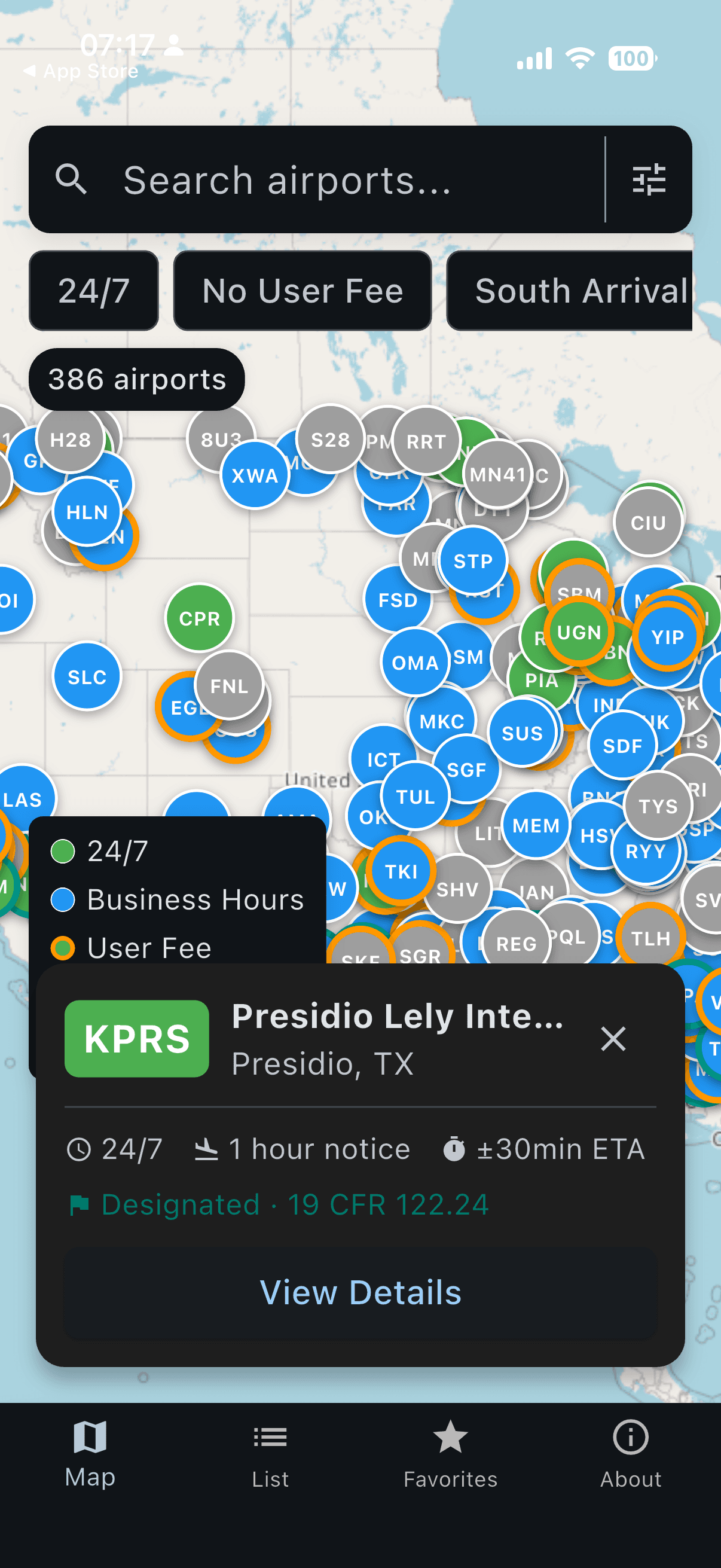
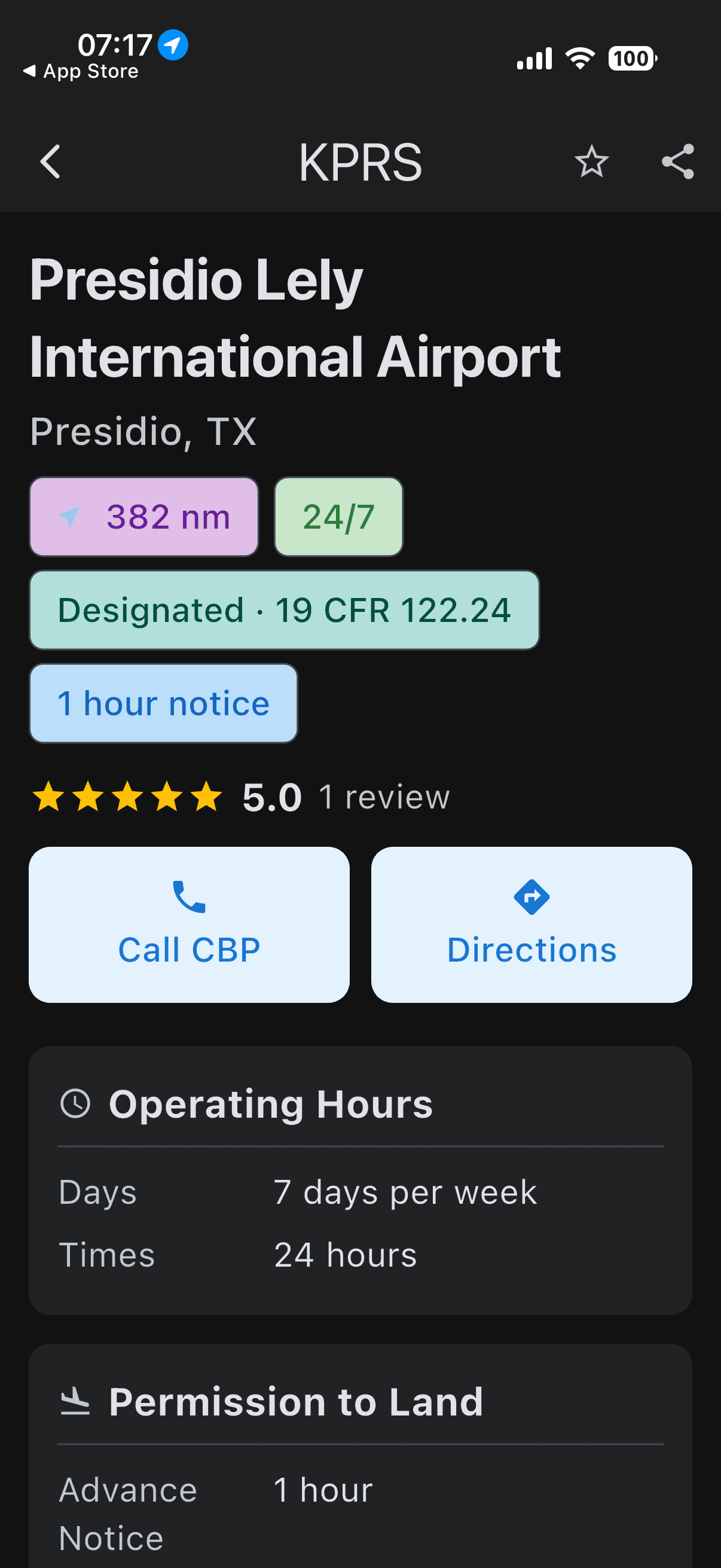
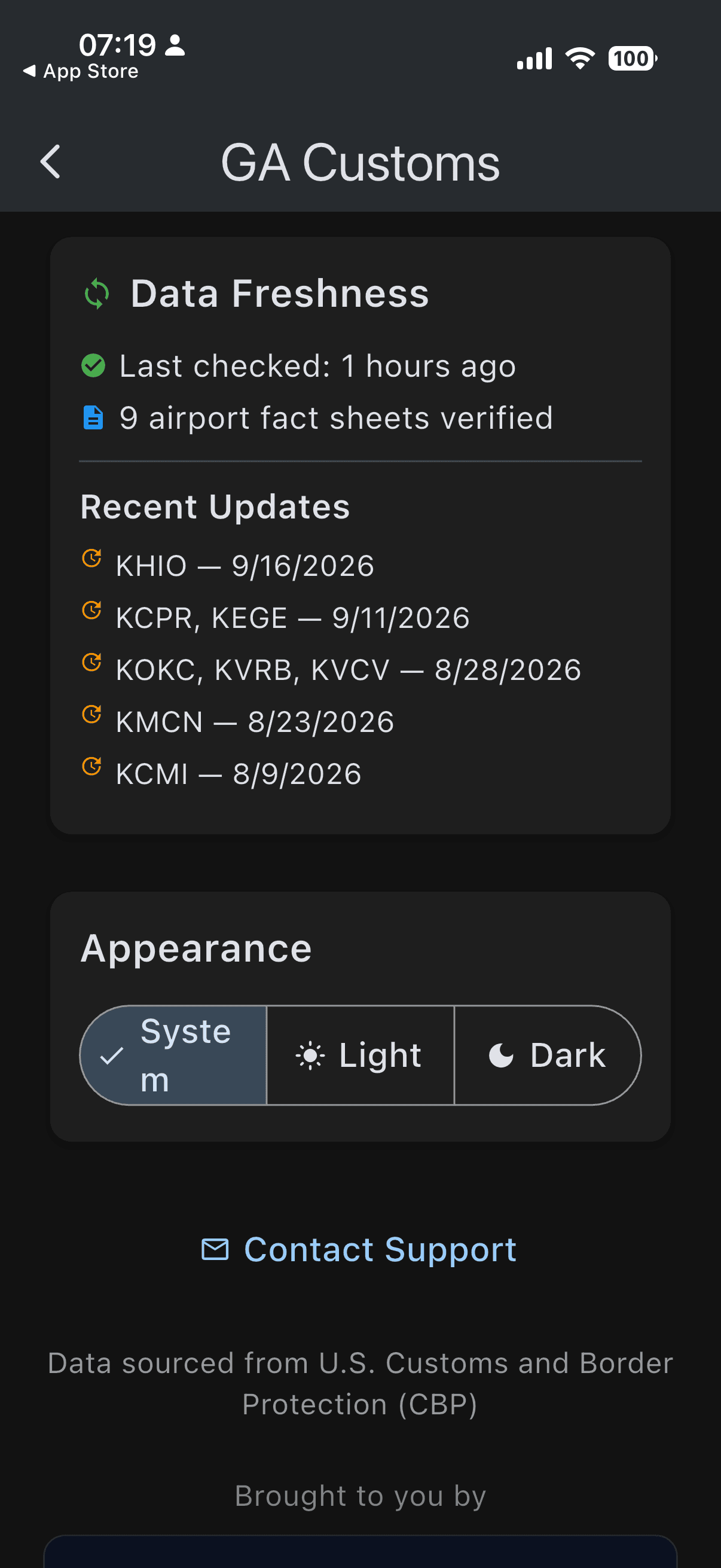
GA Customs is a free iPhone and iPad app from PlaneWX for the research half of this process: finding a customs airport and planning the first landing. According to its App Store listing (version 1.1.1, September 2026), it gives you:
- A map of U.S. airports of entry with hours and user fee status, plus distance from your location
- Filters for 24-hour airports, user fee airports and notice requirements
- A South Arrival filter, off by default, that shows only the designated airports in 19 CFR 122.24 for pilots arriving from the south without an overflight exemption
- Airport pages with hours, fees and advance notice rules from CBP, and a button to call the port
- Pilot reviews of how the clearance actually went
- Offline access to saved airport information, and to CBP fact sheets where CBP publishes one
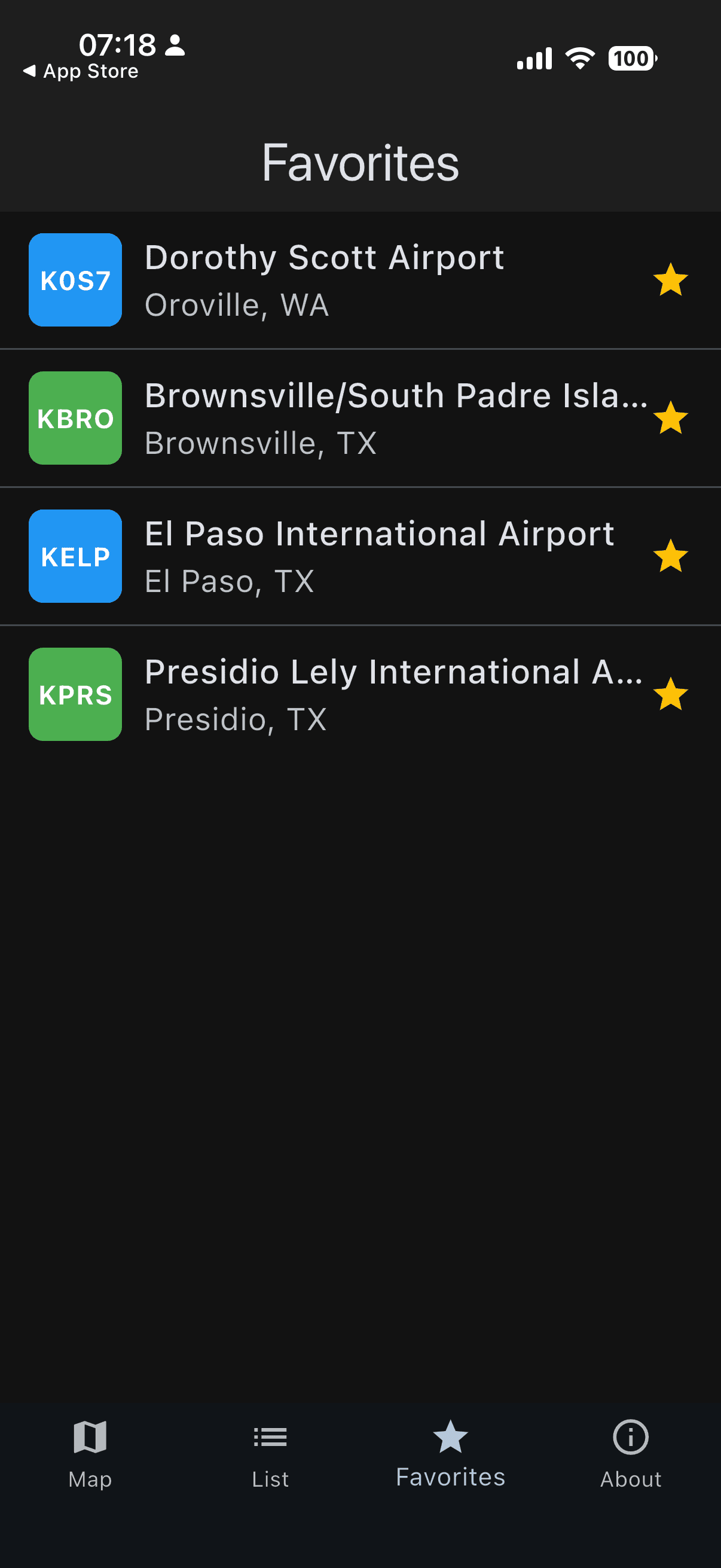
- Favorites saved on the device, with no login and no account
What it does not do matters just as much. GA Customs does not file eAPIS. You, or a party you authorize, file the manifest through CBP’s official eAPIS site at eapis.cbp.dhs.gov or another CBP-approved system. [5][7] GA Customs also does not request or grant permission to land, does not sell the user fee decal, and is not a CBP product. Its hours and procedures come from CBP, and its listing tells you to verify with CBP before you fly. GA Customs is the PlaneWX app at planewx.ai/ga-customs. It is not affiliated with the ga-customs.com website.
Customs timing is also weather timing. A permission to land window does not move because a front did. PlaneWX, which builds GA Customs, scores your route weather against your own personal minimums starting days before the flight, so you can see a weak return day while the plan is still easy to change. PlaneWX never makes the call. You are PIC for the weather decision and the customs plan alike. Open PlaneWX for the weather half of the trip. For more detail, see our guides to filing eAPIS for general aviation and choosing a U.S. airport of entry.
Frequently asked questions
Is there an app for U.S. customs airports for private pilots?
Yes. GA Customs is a free iPhone and iPad app from PlaneWX that maps U.S. airports of entry with their hours, user fee status and notice requirements, has a South Arrival filter for designated airports, and saves airport information for offline use. GA Customs does not file eAPIS. File it through CBP’s official eAPIS site, eapis.cbp.dhs.gov, or another CBP-approved system. It also does not grant permission to land. CBP’s own General Aviation Airports list and airport fact sheets remain the official sources. [1][2]
How do I find a U.S. customs airport for general aviation?
Start with CBP’s General Aviation Airports list, which shows where CBP inspection is normally available for GA arrivals, then read the airport’s CBP fact sheet for hours of service and the permission to land procedure. In the FAA Chart Supplement, AOE and LRA in the airport entry mark customs airports. Then call the CBP port to confirm. [1][2][6][11]
Where do I clear customs flying a private plane into the U.S.?
At your first landing, which must be an international airport, a landing rights airport or a user fee airport where CBP has given permission to land. If you are arriving from Mexico or another area south of the United States covered by 19 CFR 122.23 and do not hold an overflight exemption, it must be the nearest designated airport to your border or coastline crossing point. [3][4][12]
When do I have to file eAPIS for a private flight into the U.S.?
No later than 60 minutes before you depart the foreign airport for the United States. Outbound, the deadline is no later than 60 minutes before you depart the United States. After the arrival manifest, you still have to call the CBP port and get permission to land before departing. GA Customs does not file eAPIS. CBP’s official eAPIS site is eapis.cbp.dhs.gov. [5][7]
Do I need permission to land at an airport of entry?
Yes. The Chart Supplement legend still says permission is not required at an AOE, but CBP’s current procedure requires pilots to contact the CBP port of arrival directly to secure permission to land for all international arrivals at all airports. Follow CBP. [6][11]
How much is the CBP user fee decal for private aircraft?
CBP lists the Private Aircraft User Fee decal at $38.04, effective October 1, 2026, and says the price typically rises each October 1. It is bought online through DTOPS. User fee airport charges are separate and set by the airport. [7][9]
Sources
- U.S. Customs and Border Protection, CBP General Aviation Airports (list dated September 25, 2026, with CSV download).
- U.S. Customs and Border Protection, General Aviation Airport Fact Sheets (catalog).
- 19 CFR 122.31 to 122.33, notice of arrival, aircraft required to land and place of first landing (eCFR, Part 122, Subpart D).
- 19 CFR 122.24, Landing requirements for certain aircraft arriving from areas south of U.S. (eCFR).
- 19 CFR 122.22, Electronic manifest requirement for all individuals onboard private aircraft arriving in and departing from the United States (eCFR).
- U.S. Customs and Border Protection, General Aviation Processing (page last modified September 29, 2026).
- U.S. Customs and Border Protection, General Aviation Processing FAQs (page last modified September 30, 2026).
- 19 CFR 122.1, General definitions (eCFR, current as of September 29, 2026).
- 19 CFR 122.12 to 122.15, international airports, landing rights airports and user fee airports (eCFR, Part 122, Subpart B).
- FAA, Pilot/Controller Glossary (AIM Basic with Change 3, July 9, 2026), International Airport.
- FAA, Chart Supplement, Southeast, September 3 to October 29, 2026: Airport/Facility Directory Legend item 14 and the Fort Lauderdale Executive (KFXE) entry.
- 19 CFR 122.23, Certain aircraft arriving from areas south of the U.S. (eCFR).
- FAA, Aeronautical Information Manual, paragraph 5‑6‑5, Civil Aircraft Operations To or From U.S. Territorial Airspace.
- 19 CFR 122.25, Exemption from special landing requirements (eCFR).
- U.S. Customs and Border Protection, General Aviation (GA) Arrival and Departure Procedures fact sheet, Publication Number 5398‑0226, February 2026.
