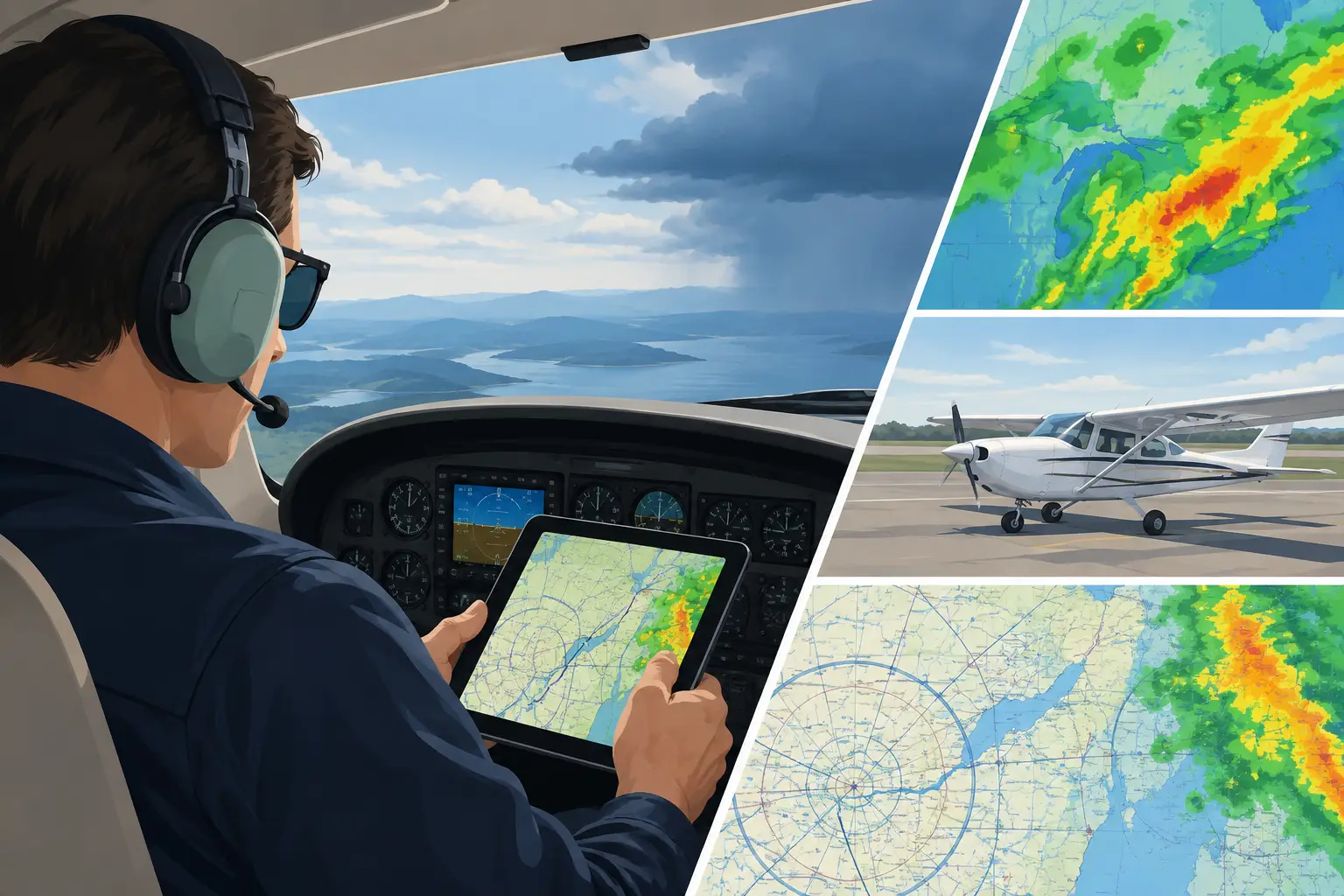
The hardest go/no-go decisions often begin days before the airplane leaves the ramp. When should pilots delay travel commitments? Usually when the weather picture is uncertain enough that a canceled hotel, flexible meeting, or backup airline ticket is cheaper than being forced into a bad decision with bags packed and people waiting.
That does not mean canceling every trip because a five-day forecast has a few rain icons. It means recognizing the difference between ordinary forecast uncertainty and a pattern that is likely to narrow your safe options. The goal is not to predict the exact ceiling at 1400 local three days from now. The goal is to preserve choices while there is still time to use them.
When Should Pilots Delay Travel Commitments?
Delay or soften a commitment when the mission depends on a narrow weather window and the larger pattern is working against you. A VFR-only trip over terrain, a single-engine night arrival into a coastal airport, or an IFR flight requiring a low approach with limited alternates all deserve more caution than a daytime trip with multiple capable airports along the route.
The signal is rarely one forecast number. It is the combination of a deteriorating synoptic setup, timing uncertainty, and low operational margin. An AFD may describe a frontal boundary slowing over your route, repeated rounds of convection, persistent low-level moisture, or uncertainty in the position of a coastal low. The NBM may show increasing probabilities of low ceilings or meaningful precipitation. Neither tells you exactly what will happen at your airport, but together they can tell you that committing now would create pressure later.
A useful question is not, “Can I probably make this trip?” Ask, “If the pattern verifies on its worse reasonable edge, do I still have an acceptable plan?” If the answer requires threading a short gap, accepting a marginal alternate, or arriving after your personal fatigue limit, the commitment is already too firm.
The pattern is deteriorating, not merely imperfect
A forecast that is imperfect but improving can support a different decision than one that is currently flyable but trending worse. For example, widespread morning stratus lifting ahead of a dry, stabilizing air mass may leave you with a delayed departure but a workable afternoon. A deepening low, an approaching cold front, and strengthening wind fields are a different proposition, especially when the route crosses multiple weather regimes.
Read the forecast discussion language for direction. Forecasters will often identify whether confidence is growing in a frontal passage, whether timing remains uncertain, or whether convection may be scattered versus organized. This is where the AFD earns its place in early planning. It gives context that a row of app icons cannot: why conditions may change, where the forecast is fragile, and what the next forecast cycle may resolve.
If the trend is deteriorating and your mission has little slack, delay the nonrefundable parts first. Move the meeting, choose a refundable hotel rate, arrange a car, or book an airline backup. Those are not signs of weak decision-making. They are how you keep weather from turning a normal trip into a pressure-packed launch.
Your route has no good escape valve
A destination forecast can look manageable while the route is not. This is common on longer business and family trips, where the departure and arrival both show acceptable conditions but a frontal band, mountain obscuration, icing layer, or widespread low ceilings sits in between.
Before committing, identify your actual escape valves: airports with approaches you can use, fuel availability, runway length, terrain, forecast trends, and a realistic path to get there. An alternate on paper is not much help if it is also likely to be below your personal minimums, affected by the same convective line, or located beyond the fuel margin created by a reroute.
This matters most when the weather system is broad. AIRMET Sierra for widespread mountain obscuration or IFR conditions, an icing AIRMET with a freezing level that blocks your preferred altitude, or a SIGMET for organized convection should change the conversation from destination planning to route survivability. PIREPs then become especially valuable as departure approaches, because they tell you whether the expected problem is already materializing.
External Pressure Is a Weather Hazard
The weather does not care whether your family has checked out of the hotel or whether a client expects you at 0900. You do. That is why travel commitments deserve the same honest risk review as fuel, runway, and aircraft performance.
PAVE is useful here because the “P” is not just certificates and currency. It includes fatigue, illness, recency, and the mental load of a schedule you are trying to save. The “E” includes the pressure created by a prepaid resort, a wedding, a meeting, or the simple embarrassment of changing plans. If those factors make it harder to say no at the airport, deal with them before they become immediate.
A practical rule: if you would be uncomfortable explaining a delay to the people traveling with you, your commitment may already be too rigid. Build the expectation early that personal aircraft travel is responsive to weather. Tell passengers when the decision window is, what could change it, and what the backup looks like. That conversation is far easier on Tuesday than it is on Friday morning with a 400-foot ceiling and a gusty crosswind.
Know the difference between delay and cancellation
Delaying a commitment is not the same as canceling a mission. Sometimes the right move is to leave a day early, depart after the morning fog burns off, reposition before a system arrives, or make the outbound trip by airline and fly the airplane home later. These choices can protect both the mission and the pilot’s judgment.
The trade-off is real. Flexibility costs money, and changing plans is inconvenient. But compare that cost with the operational alternatives: flying tired to preserve a meeting, accepting a marginal arrival after dark, or waiting until the only remaining option is a rushed decision. The earlier you identify a weather-driven risk, the more affordable and sensible your alternatives tend to be.
For aircraft that are capable in weather, the question changes but does not disappear. An instrument rating, onboard weather, ice protection, and a fast airplane expand options. They do not erase the consequences of a widespread low-pressure system, embedded convective threat, or several hours of unfavorable winds with a thin fuel reserve. Capability should widen your margin, not justify spending it.
Build Commitment Gates Before the Forecast Tightens
Set decision gates at the same time you make the trip plan. At five to seven days, assess the broad pattern and decide whether reservations need flexibility. At 72 hours, decide whether the mission still has enough route and timing options to be worth protecting. At 24 to 48 hours, use the emerging TAFs, model trends, and forecast discussions to choose a primary plan and a real backup. On departure day, return to the tools you already use for current METARs, TAFs, radar, NOTAMs, winds, PIREPs, and advisories.
The gates should be personal. A pilot comfortable with a 600-2 arrival into a familiar airport in a well-equipped airplane may have a different threshold than a pilot whose practical minimum is 1,500 and 3. Neither is a character test. What matters is defining the threshold before the schedule starts negotiating for you.
PlaneWX was built for this earlier part of the decision, when there is no TAF yet but you still need to decide whether to make promises. Its Synoptic Intelligence™ brings together AFDs along a route and calibrates that picture against NBM probabilities, then applies your aircraft, ratings, experience, and minimums to a personalized WX Score. It is decision support for deciding how firm to make the commitment, not a substitute for your normal preflight work.
The best travel plan is not the one that assumes every forecast improves. It is the one that leaves you room to act if it does not. Give yourself that room while the calendar is still flexible. Your passengers, your aircraft, and your future self will appreciate the confidence to go, or the courage to stay™.