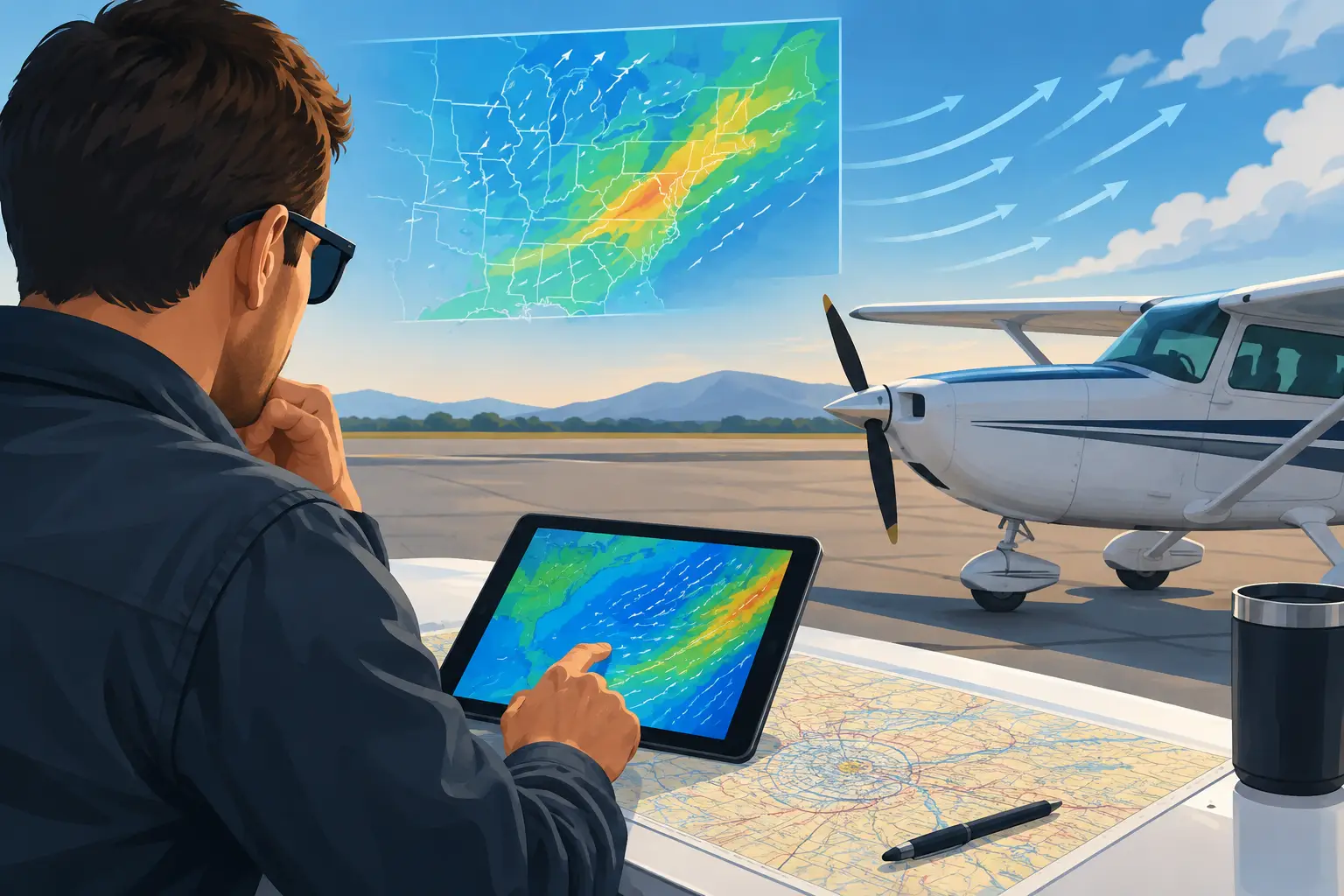
The question, “will winds change before departure,” usually arrives when the bags are packed and the forecast wind arrow is pointed directly across the runway. Maybe the family is expecting to leave Friday morning. Maybe you have a Monday meeting two states away. The surface forecast looks marginal now, but your departure is still 48 or 72 hours out. You do not need a promise that it will improve. You need to know whether the weather pattern gives you a reasonable basis to plan around a change.
That distinction matters. Wind is rarely the whole go/no-go decision, but it can drive every other part of it: runway choice, fuel, terrain routing, turbulence, cloud layers, and the margin you will have when an arrival is already busy. The right answer is often, “yes, winds will change.” The operational question is whether they will change in your favor, on your schedule, and by enough to matter.
Will Winds Change Before Departure? Start With the Cause
A wind forecast is more useful when you understand what is driving it. At three to five days out, do not fixate on a single model run or a single forecast gust number. Look for the larger feature controlling the pressure gradient: a cold front, a deepening low, a broad high building in behind a system, or a persistent ridge that is locking the pattern in place.
If a cold front is forecast to cross your route overnight, a wind shift is likely. But “likely” has several moving parts. The front may arrive six hours early or late. It may pass with a sharp line of convection, or it may come through dry with a gradual veer. Behind it, winds may shift northwest but remain too strong for your comfort until the pressure gradient relaxes the following day.
That is why a simple forecast of south winds becoming northwest winds is not enough. Ask what happens during the transition. Is your planned departure ahead of the front, in the frontal passage, or well behind it? A favorable runway component after passage does not help much if the airport is dealing with gusty frontal winds, low ceilings, or embedded cells at your actual departure time.
Area Forecast Discussions are particularly valuable here. The AFD often explains the timing disagreement forecasters are watching, whether a secondary front is possible, and how quickly winds should ease after a system moves through. It gives you the reasoning behind the icons and wind barbs.
Surface Wind Is Only One Layer of the Decision
A 12-knot crosswind at the departure airport can coexist with a very different problem at 6,000 or 10,000 feet. The winds aloft may turn a comfortable trip into a long one, create mechanical turbulence downwind of terrain, or make an otherwise acceptable fuel plan tight.
For an instrument pilot, the vertical wind profile also changes the arrival picture. A strong low-level jet can mean a manageable surface wind but significant wind shear near the approach. A stable post-frontal airmass may bring clear skies and brisk northwest winds at the surface, while turbulence remains a concern below the ridgelines or on the lee side of higher terrain.
Read the route, not just the endpoints. A northeast wind at your home field may be harmless, while the same flow is a poor fit for a mountain pass, a coastal destination, or an airport with limited runway options. If you fly a light piston single, your practical line may be very different from the pilot in a heavier turboprop. That is not conservatism or bravado. It is aircraft capability and personal minimums applied honestly.
Timing Is the Forecast You Are Really Buying
Most wind surprises are timing surprises. The forecast did not necessarily miss the wind shift. It missed when the shift would happen, when the gusts would peak, or when the boundary would stall.
When departure is more than 24 hours away, build your plan around windows rather than a single point forecast. If Saturday morning looks like the likely post-frontal improvement window, keep an eye on Friday evening as a possible earlier option and Saturday afternoon as a possible fallback. If the system is slowing, you have already identified the consequence before the family is in the car.
This is where model agreement matters more than model precision. When the NBM probability guidance, the forecast discussion, and the broader synoptic setup all point toward winds easing after 1500Z, that is a useful planning signal. When they disagree substantially, the disagreement is information too. It tells you not to make a hotel cancellation or business commitment based on one optimistic wind forecast.
Short-range tools have a different job. As the flight gets closer, HRRR guidance can help refine the timing of a frontal band, sea-breeze shift, or convective outflow boundary. TAFs, METAR trends, PIREPs, SIGMETs, and AIRMETs then become central to the final operational call. The farther out you are, the more you should think in probabilities and scenarios. The closer you are, the more you should verify what the atmosphere is actually doing.
Separate a Manageable Wind From a Bad Mission
A crosswind number alone can create false comfort. Suppose the forecast is 14 gusting 22, 50 degrees off the runway. That may be within your demonstrated comfort on a dry, wide runway near home. It may be a different decision at night, after a long leg, with a wet runway, a gust spread that is still rising, and a passenger who needs to be at a wedding in two hours.
Use PAVE the way it was intended: as a practical check against pressure, not a box to check after you have already decided. Pilot means current proficiency with gusty crosswinds and the type of approach expected. Aircraft means runway performance, crosswind capability, fuel reserves, and whether the ride is likely to become a factor. enVironment means terrain, runway orientation, alternates, and the wind at every meaningful point on the route. External pressures are usually the loudest voice in the room, especially when changing plans costs money or disappoints people.
A useful personal-minimums question is not, “Can I land in this?” It is, “If the forecast is wrong by one notch, does this mission still work?” If the answer depends on every gust arriving exactly as forecast, you have not built a margin. You have built a bet.
How to Plan Earlier Without Pretending You Know the Future
Three or four days before departure, identify the wind-driving system and the likely transition period. Read the relevant AFDs along your route, especially near fronts, terrain, and coastal areas. Compare the narrative with NBM probability guidance rather than treating either one as a standalone answer.
Then make a conditional decision. You might tell your passenger, “Friday afternoon is still in play, but Saturday morning is the cleaner window if the front slows.” Or tell a client you are holding a rental car until noon rather than promising a 9 a.m. arrival. Those are not signs of indecision. They are the advantage of seeing weather risk before the TAF window opens.
As departure approaches, narrow the question. Are the winds shifting on schedule? Are gusts behaving as expected? Is the pressure gradient relaxing behind the front, or does the latest discussion now call for persistent strong winds? Monitor actual observations at airports that sit upstream of your route. They can show whether the boundary is moving faster, slower, or differently than forecast.
PlaneWX was built for this middle ground in the decision process. Its Synoptic Intelligence™ pulls together the forecast-office reasoning along a route and calibrates it against NOAA probabilistic guidance, so the pilot can see whether a developing pattern supports the mission before last-minute weather products become available. The WX Score is not a substitute for judgment. It is a way to frame the probability of a viable flight around your aircraft, experience, and minimums while there is still time to adjust the plan.
The wind will change. It always does. The better question is whether the larger pattern is becoming more flyable or less flyable by the time you need to launch. Give yourself enough lead time to answer that honestly, and you will have more confidence to go, or the courage to stay™.