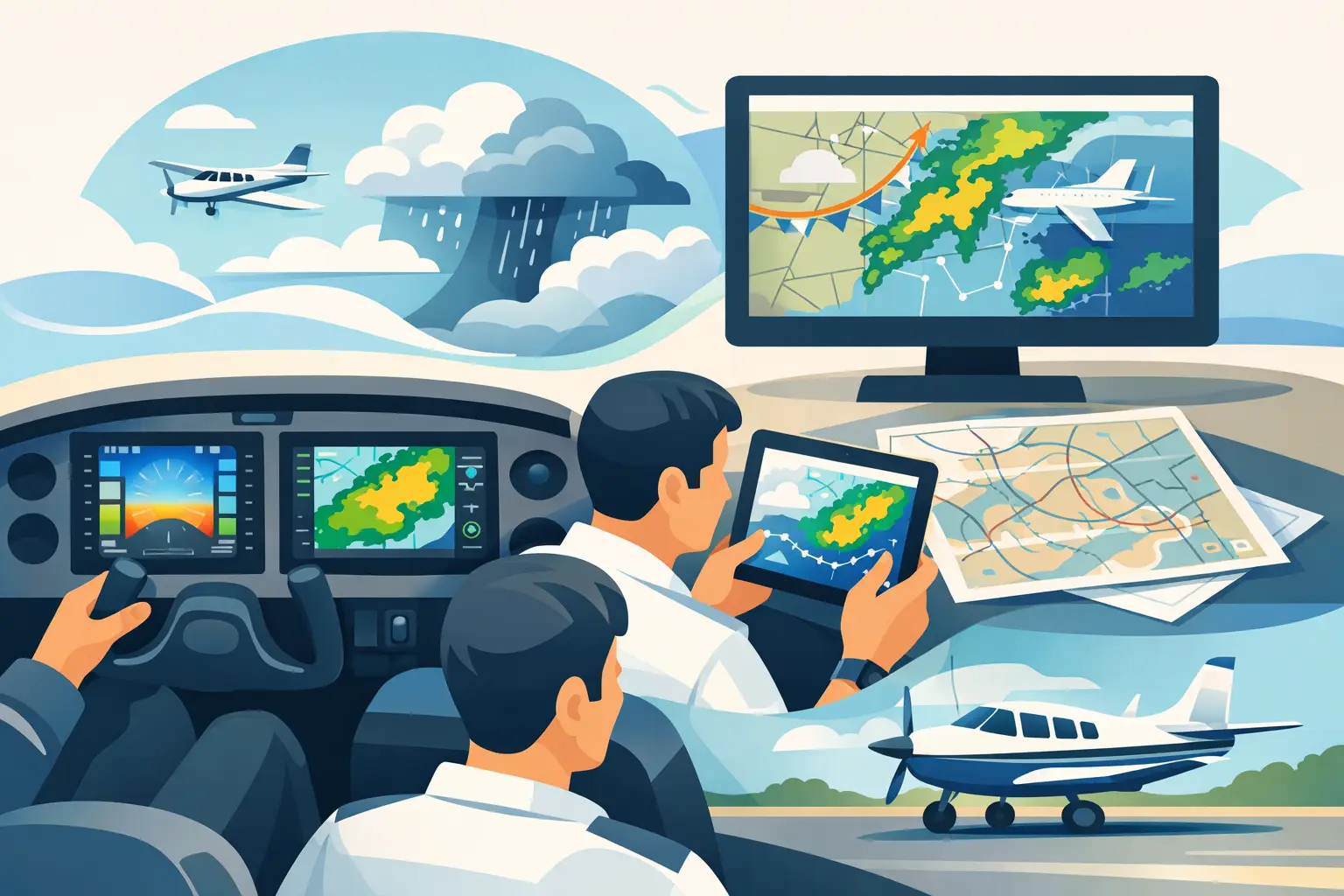
You know the moment. It is Wednesday, the trip is Friday, the hotel is booked, your passenger has already arranged time off, and the only honest answer to "are we still going?" is "I don't know yet." That is where AI weather forecasting aviation matters most - not at engine start, but days earlier, when the pressure starts building and the usual tools still have a blind spot.
For most of us flying real trips in GA, weather decisions do not begin with the TAF. They begin when we commit to the trip. By the time the METARs, TAFs, PIREPs, SIGMETs, and AIRMETs line up into a clear picture, you've often already made promises. The real value in better forecasting is not novelty. It is buying back time to think clearly.
Where AI weather forecasting aviation actually helps
Let's keep this grounded. AI is not magic, and it does not make weather uncertainty disappear. What it can do well is sort through a lot of signal faster than any one pilot can, especially when the question is not "what is the weather at one airport right now?" but "how is this whole route likely to behave over the next three to five days?"
That matters because the go or no-go call is rarely driven by a single point forecast. It is driven by patterns. Is the system speeding up or slowing down? Is the moisture deeper than first advertised? Are ceilings likely to be a nuisance or a trip-killer? Is that late-day convective risk isolated enough for a morning launch, or is the whole route trending unstable? Those are the questions pilots ask in the real world, and they sit in the space between raw weather products and a workable decision.
A good decision support system can compare forecast discussions, model blends, route geography, and timing in a way that starts to resemble how an experienced pilot thinks. Not replacing pilot judgment - supporting it. That distinction matters.
Why the 72-hour problem is different
Inside 24 hours, the toolset is familiar and pretty strong. TAFs, HRRR, MOS, radar trends, surface analysis, and obs give you a much tighter loop. The challenge beyond that is not lack of data. It is too much uncertainty spread across too many sources.
Area Forecast Discussions are a perfect example. They are often the most honest forecast product in the stack because they tell you what the forecaster is worried about, where the confidence is weak, and what could change. But on a multi-state route, reading AFDs from a string of Weather Forecast Offices takes time, and the useful part is not just each discussion by itself. It is the combined picture.
That is where AI weather forecasting in aviation starts to earn its keep. If a system can synthesize AFDs along your route, compare them to probabilistic guidance like the NBM, and surface the trend that actually matters to your mission, you get earlier visibility into whether Friday is shaping up as a reasonable plan or a likely scrub.
The key phrase is earlier visibility. Not certainty.
Good aviation weather AI should sound more like a pilot than a marketer
If a tool promises to "tell you whether to fly," be skeptical. Weather is only one side of the decision. PAVE still applies. Pilot, Aircraft, enVironment, External pressures. Any system that ignores the last category is missing the real problem, because external pressure is usually why the weather question feels hard in the first place.
A useful system should help you ask better questions sooner. If your route is showing deteriorating ceilings across the middle third, and the trend is getting worse with each update, maybe the smart move is to move the meeting, book the extra night, or tell the family now that the odds are slipping. If the pattern is holding together with manageable risk and your personal minimums fit the setup, maybe you stop second-guessing every update and prepare normally.
That kind of support is practical because it respects that each flight is personal. A 700-foot overcast and five miles may be workable for one pilot in a known route and equipped airplane, and not remotely acceptable for another. The same weather does not mean the same thing to every cockpit.
The difference between raw forecast data and decision support
Most weather tools are very good at showing data. Fewer are good at helping a pilot make a decision before the short-range products tighten up. That gap matters.
Decision support is not about one more chart layer. It is about translating a messy forecast picture into operational meaning. If the route spans four forecast regions and two frontal boundaries, the pilot does not just need more weather. The pilot needs a read on viability.
That is why personalization matters. A weather pattern that is viable for a turbine single with known ice protection, onboard radar, and a flexible schedule is not the same pattern for a normally aspirated piston single trying to get home Sunday evening. When a system calibrates forecast risk against aircraft capability, pilot experience, ratings, and personal minimums, the output gets closer to the question you actually care about: how likely is this specific flight to work?
That is the idea behind PlaneWX. It uses Synoptic Intelligence™ to synthesize AFDs along a route, calibrates them against NOAA's NBM probabilities, and returns a personalized WX Score - a 0 to 100 percent probability that the flight is viable for that pilot, in that airplane, on that route. The point is not to replace what you do in ForeFlight or Garmin Pilot later. It is to give you a better read on the trip before those short-horizon tools can.
What to watch for when using AI weather forecasting in aviation
The first thing is transparency. If a system gives you an answer without showing the reasoning, you are back to guessing. Good tools should make it clear whether the concern is ceilings, convection, wind, icing, or timing uncertainty. You need to know what is driving the probability.
The second is update behavior. Forecast confidence changes as departure approaches. A useful system should not trap you in a stale outlook from two days ago. It should refresh as new model runs, new discussions, and new observations sharpen the picture.
The third is route awareness. Airport weather by itself can be misleading on cross-country flights. Plenty of trips look fine at departure and destination while the middle 300 miles are the problem. If the system is not thinking in terms of route and timing, it is solving the wrong problem.
And the last one is humility. Weather forecasting always has edge cases. Summer convection, mountain wave, embedded icing layers, marine pushes, and frontal timing can all turn a decent forecast into a marginal day or rescue a day that looked ugly. A good system should help you understand the trend, not pretend to abolish uncertainty.
What this changes for a pilot making a real trip
The practical win is simple. You make better decisions sooner.
That might mean deciding on Tuesday that Friday's launch window is probably real, so you stop carrying unnecessary stress all week. It might mean seeing by Wednesday that the route is degrading and making an alternate plan before everyone is emotionally committed. Both outcomes are valuable. The confidence to go, or the courage to stay™, starts before the day of flight.
It also changes how you use your normal workflow. When the departure gets closer, you still do what experienced pilots do. You review the TAFs. You check METAR trends. You look at PIREPs, SIGMETs, AIRMETs, and radar. You compare the big picture to what the atmosphere is actually doing. The difference is that you are not walking into that process cold. You already know what has been driving the forecast and how the trip has been trending.
That matters because calm decisions usually come from lead time, not bravery.
The real standard is not accuracy alone
Forecast accuracy matters, obviously. But for GA pilots, the real standard is whether the tool improves judgment under pressure. Does it help you make cleaner calls when the bags are packed and the calendar is full? Does it reduce the chance that you talk yourself into waiting just one more update when the pattern is already telling you enough? Does it help you separate real opportunity from wishful thinking?
That is the standard worth using.
If you want to see your trips earlier and with more context than a 24-hour view can give you, take a look at https://www.planewx.ai. Better weather decisions rarely come from more hope. They come from better timing, better context, and enough honesty to act on what the forecast is really saying.