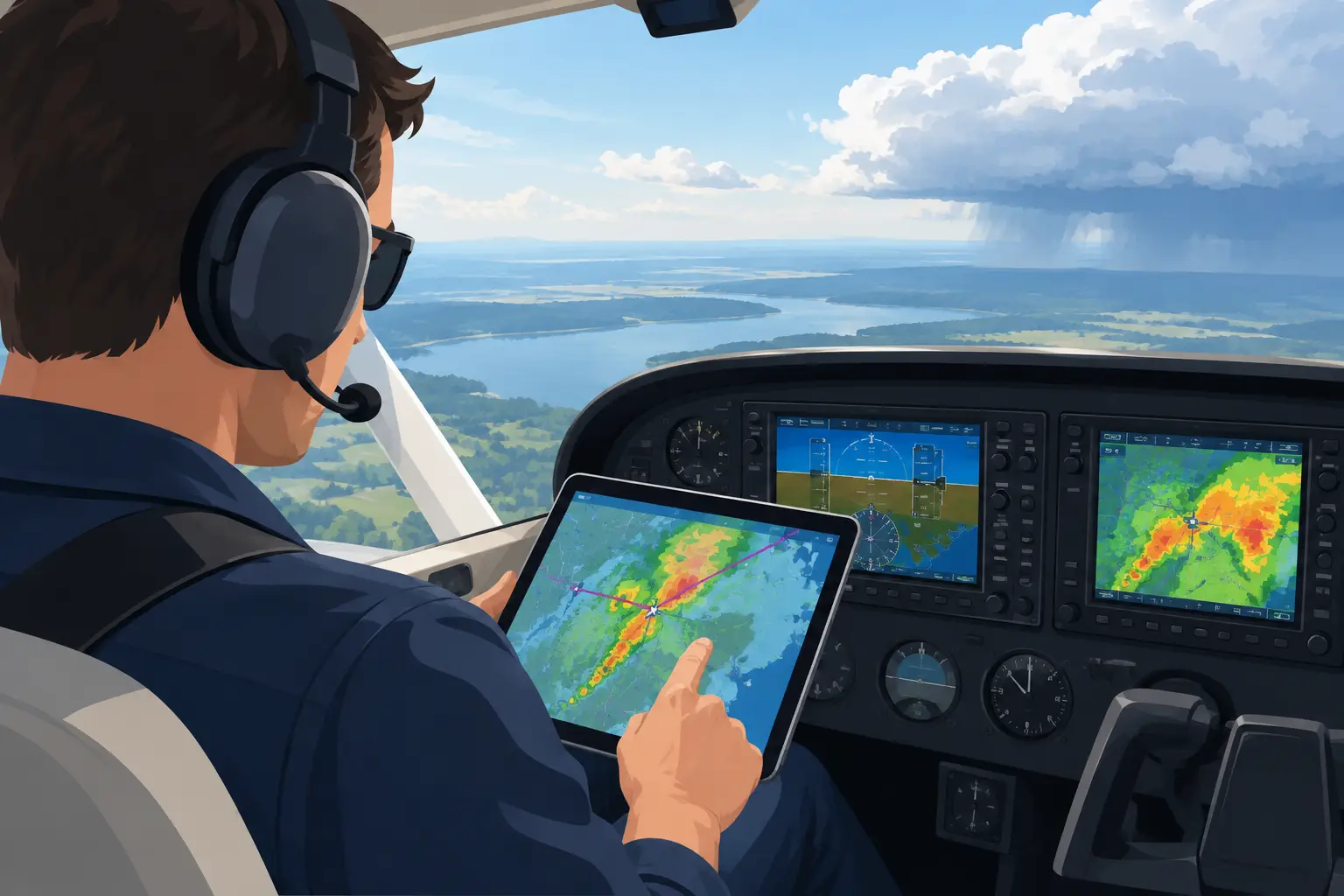
Best Pilot Weather Apps for Decision Support (2026)
Choosing among pilot weather apps is less about pretty radar and more about how early and clearly you can own the go/no-go call. EFBs put aviation weather on the tablet. Official sources keep you grounded in the same data ATC and briefers use. A decision support system (DSS) helps you brief, risk-score, and think through the flight before you ever push for taxi.
This guide compares what each category is for: ForeFlight, Garmin Pilot, Windy, aviationweather.gov (AWC), a generic EFB weather layer, and PlaneWX. PlaneWX is a pilot decision support system built around weather briefing, a FRAT (Flight Risk Assessment Tool), and a mentor network. The PIC still owns the decision. No app replaces that.
What pilots actually need from an aviation weather app
A strong aviation weather app (or stack) should help you answer three questions before you commit:
- What is the weather doing along my route and at my destination? METARs, TAFs, AIRMETs, SIGMETs, PIREPs, winds aloft, and convective outlooks that match how you fly.
- How does that weather interact with my flight? Aircraft, currency, experience, night, IFR vs VFR, and personal mins matter as much as the forecast.
- When do I need to decide? Early go/no-go beats last-minute scramble on the ramp.
Weather apps for pilots sit on a spectrum: chart-centric EFBs, official briefing portals, and DSS tools that emphasize earlier risk framing. The best aviation weather app for you depends on whether you need maps and procedures, raw official products, or structured decision support before you brief in the cockpit.
ForeFlight: strong weather briefing inside a full EFB
ForeFlight is an electronic flight bag first. Its weather briefing strengths are real: graphical layers, route-aware products, METARs/TAFs, radar and satellite, and a briefing workflow that fits how many pilots already plan flights. For charts, procedures, and in-flight awareness, it remains a core tool for a large share of GA and business aviation.
Limits show up when you treat the ForeFlight weather briefing as the whole decision process. It surfaces aviation weather well. It does not fully replace a structured FRAT, a mentor check on judgment, or a pre-commitment DSS that forces you to own personal mins and risk factors before the weather looks “good enough.” Use ForeFlight for briefing and navigation context. Pair it with a DSS when you want earlier, explicit go/no-go support.
Garmin Pilot: EFB weather for the Garmin ecosystem
Garmin Pilot serves pilots who live in the Garmin world: panel, portable, and tablet tied together. Weather layers, METARs, forecasts, and briefing-style views support planning and enroute awareness. Like ForeFlight, it is an EFB with strong aviation weather features, not a standalone decision support system.
If your aircraft and training already center on Garmin, Garmin Pilot is a natural place to view weather with your route and avionics. For earlier risk framing, FRAT discipline, and mentor input, treat it as the map-and-brief side of the stack and add a DSS when you need that layer.
Windy: the map pilots open for the big picture
Windy is one of the most popular apps for pilots, and the reason is easy to see: its wind and weather visualization is excellent, model comparison is useful, and pilots love the map. For a broad look at wind, fronts, convection, and forecast model differences, it is a strong visualization layer.
The SEO reality is different. Bare “Windy” is huge consumer demand, around 201k searches, while aviation modifiers are tiny: “windy flight” about 140, “windy aviation weather” about 50, and “windy aviation” about 40. Do not chase bare Windy as a primary SEO term. In a pilot weather stack, position it honestly as a popular map and visualization layer.
Windy is not a flight weather briefer, DSS, FRAT, or mentor tool. Use it alongside an EFB and PlaneWX DSS, not instead of them. The PIC owns the go/no-go call. PlaneWX adds decision support around weather briefing, FRAT, and mentor input, while Windy helps you see the bigger picture.
aviationweather.gov / AWC: the official source, not an app rival
The Aviation Weather Center site (aviationweather.gov) is the official public face of aviation weather products many apps re-display. METARs, TAFs, AIRMETs, SIGMETs, prog charts, and related products live here. It is not an “app competitor.” It is the reference.
Use AWC when you want primary-source products without EFB chrome, when you cross-check what an app shows, or when you brief without a subscription. It will not run your FRAT, mentor you, or structure personal mins. It gives you the weather. You still make the call.
Generic EFB weather layers: awareness, not judgment
Many EFBs and flight apps add radar, satellite, METAR pins, and basic forecasts as layers on a map. Those layers are excellent for situational awareness once you have already decided the flight is plausible. They are weaker as a first-pass flight weather briefer when you need to weigh experience, night, icing airmets, and destination alternates against a written risk picture.
Think of generic weather layers as “what is out there,” not “should I go.”
PlaneWX: pilot decision support before you commit
PlaneWX is a pilot decision support system, not a chart or nav replacement. It is built to help you work the go/no-go problem earlier with three pillars:
- Weather briefing oriented to decision support, not just product dumps
- FRAT so risk factors sit next to the weather, not in a separate mental checklist you might skip
- Mentor network so judgment can be pressure-tested when the call is not obvious
PlaneWX complements ForeFlight and Garmin Pilot. Keep your EFB for charts, procedures, and in-flight weather. Use PlaneWX when you want structured aviation weather briefing and risk framing before you lock in the plan. The PIC still owns go/no-go. PlaneWX does not claim to replace that responsibility.
How to choose among pilot weather apps in 2026
| Need | Strong fit | |------|------------| | Charts, procedures, enroute weather | ForeFlight or Garmin Pilot | | Official products / cross-check | aviationweather.gov (AWC) | | Early go/no-go, FRAT, mentor input | PlaneWX DSS | | Big-picture wind and model visualization | Windy | | Quick map awareness | EFB weather layers |
Practical stack for many GA pilots:
- Start with a DSS-style brief and FRAT when conditions are marginal or personal mins are in play.
- Pull or confirm products from AWC or your EFB briefing.
- Fly with the EFB you trust for nav and in-cockpit weather.
That order keeps decision support upstream of “the radar looks okay.”
Aviation weather briefing vs decision support
An aviation weather briefing answers: what products apply to this route and time? A flight weather briefer (human or digital) organizes those products. Decision support asks the next question: given this pilot, this aircraft, and these mins, is the risk acceptable, and what would change the call?
ForeFlight weather briefing and similar EFB tools excel at the first job. PlaneWX is aimed at the second, earlier in the timeline, without pretending to replace your EFB or your certificate.
Bottom line
The best pilot weather apps in 2026 are not a single winner. ForeFlight and Garmin Pilot remain excellent EFBs with serious aviation weather capability. Windy is a strong map and visualization layer for the big picture. AWC remains the official source. PlaneWX fills the DSS gap: weather briefing plus FRAT plus mentor network for earlier, clearer go/no-go ownership.
For airports of entry and customs discovery, the PlaneWX family also includes GA Customs, with more tools in the PlaneWX apps hub.
PIC decides. Tools inform. Stack them that way.
Ready to brief with decision support? Sign up for PlaneWX