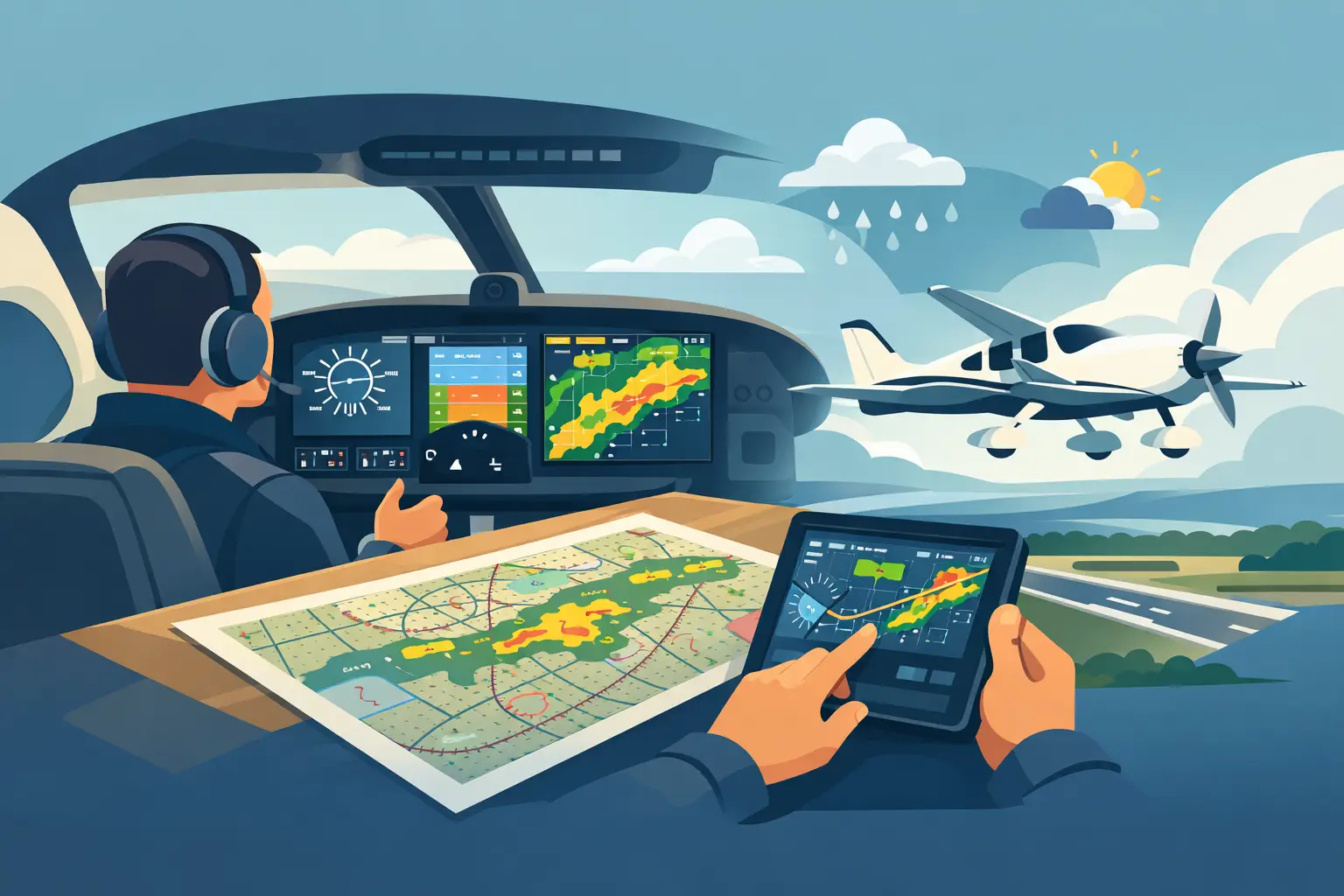
The hard part of many weather calls is not two hours before departure. It is three days before, when the hotel is booked, the meeting is on the calendar, your passenger has already packed, and there is no TAF yet to lean on. That is where the real question shows up: can AI improve preflight weather decisions in a way that actually helps a pilot make a better call?
My view is yes - but only if it helps with judgment instead of pretending to replace it.
Most pilots flying real trips already know how to read a METAR, scan a TAF, check radar, and work through PIREPs, AIRMETs, and SIGMETs. The problem is not a lack of weather products. The problem is timing. Traditional tools get much better as departure gets close. But the pressure to decide often starts long before the forecast becomes concrete.
That gap matters. It is where external pressure starts building. You tell your family you are probably going. You schedule the customer visit. You decide whether to position the airplane. Then, 24 hours out, the picture sharpens and you realize the trend is moving the wrong way. By then, the emotional cost of canceling is higher than it should be.
Where AI can improve preflight weather decisions
Used well, AI can help before the weather is precise. That sounds backward, but it is exactly the use case. Not to produce fake certainty, and not to spit out a yes-or-no answer, but to organize weak early signals into something a pilot can use.
A machine is very good at one thing pilots do not have time for: reading a huge amount of forecast discussion and numerical guidance across an entire route, then finding pattern agreement and conflict. If you are planning a 600-mile trip three or four days out, the useful signal is rarely in one airport forecast. It is in the broader setup. Is the trough slowing down? Is low cloud likely to linger behind the front longer than the model first suggested? Are convective chances broad and noisy, or are they narrowing into a time window you might actually work with?
That is where a decision support system can earn its keep. It can synthesize AFDs from multiple Weather Forecast Offices, compare that human forecaster reasoning against NBM probabilities and short-range trends as the flight gets closer, and give the pilot a route-specific probability tied to the mission. That is much more useful than a generic statement that conditions may be marginal.
For a pilot, the value is not automation. The value is lead time.
What good decision support looks like in the cockpit planning cycle
If the system is any good, it should make your planning earlier, calmer, and more honest.
Three to five days out, I do not need a cartoon forecast pretending to know my exact ceiling at 1500 local. I need to know whether the weather pattern is trending toward a trip I should keep on the calendar, hedge with an airline backup, or start backing away from. That is a PAVE problem as much as a weather problem. The Aircraft may be capable. The enVironment may still be questionable. The External pressures are already rising.
A useful system takes the route, the season, the synoptic pattern, and the pilot profile and turns them into a probability with context. Not just bad weather somewhere, but whether this pilot in this airplane, with these personal minimums, is likely to have a viable flight. That is a better planning question.
Closer in, the job changes. Once TAFs, METARs, PIREPs, and model refreshes tighten up, the system should not fight the newer data. It should refresh, adapt, and show whether the trend is improving or deteriorating. The point is not to lock in a decision early. The point is to avoid getting blindsided late.
Can AI improve preflight weather decisions for every flight?
No. And that matters.
If you are launching on a short local hop with flexible timing and ten alternates, the benefit is smaller. If the mission is a multistate cross-country with passengers, hotel reservations, rental cars, and a narrow return window, the benefit is much larger. The more logistics and external pressure attached to the trip, the more valuable earlier weather insight becomes.
It also depends on the kind of weather. AI is generally more helpful with broad pattern recognition than with tiny, highly local surprises. A widespread IFR setup, post-frontal stratus deck, winter system, marine layer push, or organized convective regime can often be framed meaningfully days ahead. A rogue afternoon cell over one fix or a narrow patch of valley fog is harder. Any system that suggests otherwise is selling certainty it does not have.
That is why I trust decision support more when it shows probability than when it gives commands. Pilots do not need another magic answer machine. We need a better read on the odds.
The real trade-off: confidence versus complacency
This is the part worth saying plainly. Better tools can improve decisions, but they can also create overconfidence if pilots stop thinking.
If a system gives you a strong WX Score three days out, that does not mean the flight is solved. It means the flight currently looks viable for your profile, based on the data and the pattern as understood at that moment. That is useful. It is not permission to quit monitoring.
The same goes the other way. A poor early score is not always a cancellation. Sometimes the pattern is unstable and the right move is to wait for another model cycle, another AFD update, or the first TAFs to come into range. Good decision support should reduce false confidence and false pessimism at the same time.
That balance is what many pilots are after. Not a machine that replaces experience, but one that acts like a disciplined second set of eyes that never gets tired and never skips the 14th forecast discussion because dinner is on the table.
Why route context matters more than airport weather
A lot of weather tools still pull pilots into an airport-by-airport mindset. That is fine near departure. It is not enough for early decision-making.
Most trip-killing weather is not a single bad destination METAR. It is the route. It is icing in the climb, embedded convection across the middle third, low ceilings at the destination with no practical alternate, or a headwind and weather combination that turns a routine leg into a fuel and fatigue problem. Preflight weather judgment should match the actual mission, not just the endpoints.
That is why route synthesis matters. Reading one AFD can be enlightening. Reading ten across your route can change the whole picture. One office may emphasize convective timing uncertainty while another flags low confidence in frontal speed. A machine can gather that fast. A pilot can then spend time on the decision, not on the scavenger hunt.
This is the logic behind PlaneWX. It was built to cover the period before the normal briefing flow gets strong - when pilots are making real commitments with limited clarity. Synoptic Intelligence™ pulls together the route-wide forecast reasoning, calibrates it against NOAA model probability data, and turns it into a personalized WX Score based on the pilot, airplane, and mission. That does not remove uncertainty. It puts shape around it earlier.
So, can AI improve preflight weather decisions?
Yes, when it respects the job.
The job is not to outvote the pilot. The job is to help the pilot see farther ahead, understand trend and probability, and recognize when external pressure is getting ahead of the weather picture. That is especially valuable in the messy middle window beyond 24 hours, before the normal tools really settle in.
For serious GA travel, that earlier visibility changes behavior. You make backup plans sooner. You stop telling yourself that a shaky trip will probably work out just because you want it to. And when the weather improves, you can go with a clearer head instead of rushing through a last-minute scramble.
That is the real benefit. Better decisions are usually not dramatic. They are quieter than that. More measured. More timely. More honest.
The confidence to go, or the courage to stay™, starts before engine start. If you want help with the part of the decision that happens days before the TAFs show up, that is the place to start.