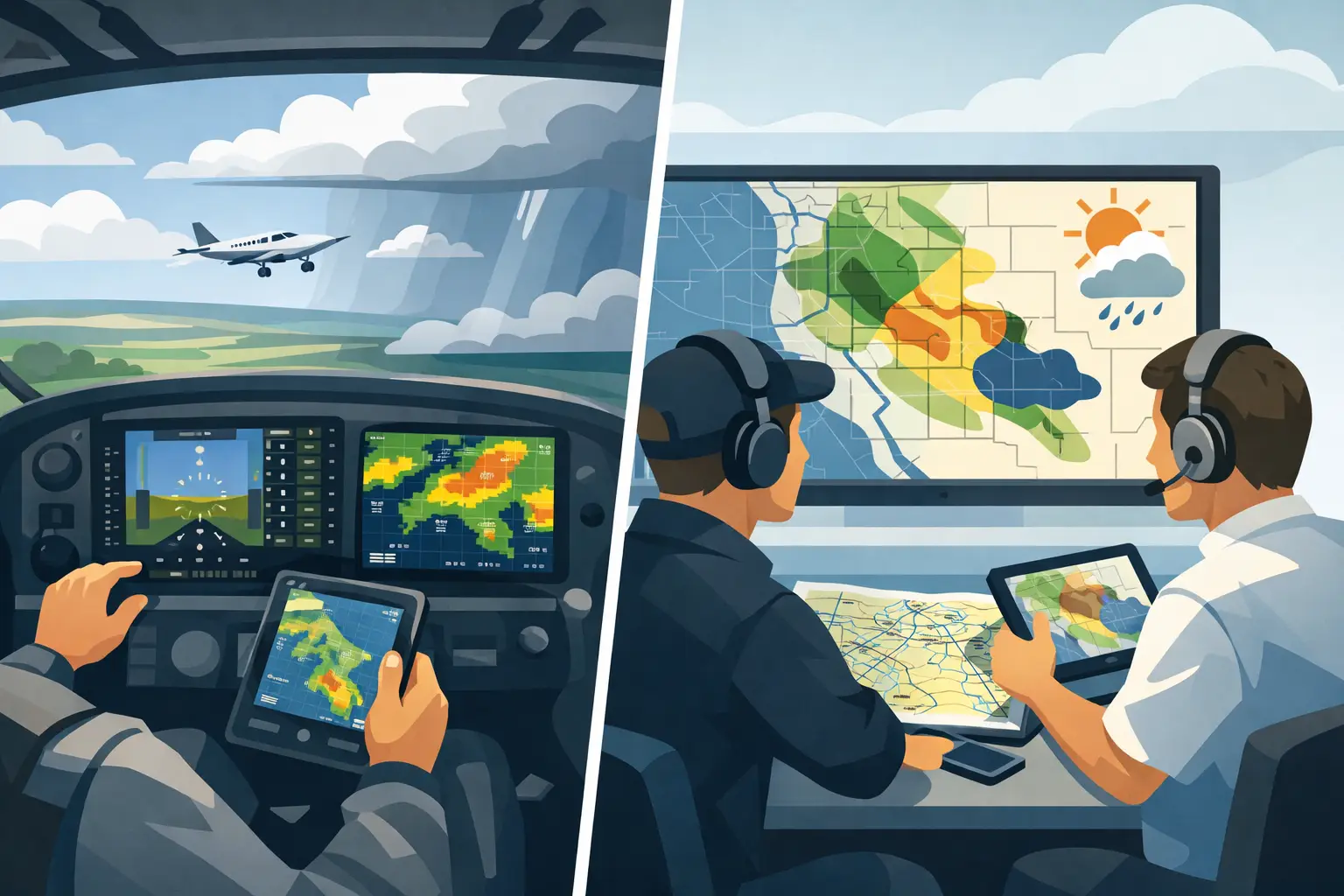
Thursday looks flyable when you check on Monday. By Tuesday night, the route has softened into maybe. By Wednesday morning, you're staring at a TAF that seems to disagree with what the broader pattern had been hinting at all along. That is exactly where the probabilistic weather briefing vs deterministic forecast question matters for real-world GA flying - not in a classroom, but when the hotel is booked, the meeting is on the calendar, and your family is asking what time you're leaving.
For most of us, a deterministic forecast is the weather version of a single answer. Ceiling 2,500. Winds 220 at 14. Showers after 18Z. It gives you one expected outcome for one place and time. That's useful, especially close in. TAFs, model output, and app displays often present weather this way because a single number is easy to read and easy to brief.
A probabilistic weather briefing answers a different question. Not what is most likely to happen at one point, but how likely a range of outcomes is across your route, timing, and personal limits. For a pilot, that distinction is not academic. It's the difference between planning around uncertainty and being surprised by it.
Probabilistic weather briefing vs deterministic forecast in practice
If you're flying your own airplane for real trips, you need both. The mistake is treating them as interchangeable.
A deterministic forecast is strongest when the event is close, the signal is clear, and your decision window is short. The 18Z TAF, current METAR trends, nearby PIREPs, the latest radar picture, and short-range guidance like HRRR all help you decide what the next few hours probably look like. That's tactical weather.
A probabilistic weather briefing is stronger earlier, when the atmosphere still has room to move around. Three to five days out, a forecast that says your destination will be broken at 2,000 feet at 2100Z can sound precise, but it often carries more confidence than it deserves. At that range, what matters more is whether the pattern supports a 70 percent chance of MVFR along the route, a 40 percent chance of convective disruption near your arrival time, or a steadily improving trend as the system exits.
That kind of picture is far more useful when you're making commitments before TAFs even exist.
Why deterministic forecasts can mislead good pilots
This is not a knock on deterministic tools. We all use them. The issue is how easy they are to over-trust, especially under pressure.
A deterministic forecast gives the brain relief. It feels like clarity. You see a neat line of numbers, maybe a clean forecast period, and you naturally start building a plan around it. Departure time, fuel stop, hotel checkout, passenger expectations. The problem is that the atmosphere does not care how badly you want the answer to stay stable.
When a trough speeds up by six hours, or moisture overperforms, or a frontal boundary stalls just a bit farther west, that tidy single-answer forecast can swing fast. Then it looks like the weather changed its mind. Usually it didn't. Usually the uncertainty was there from the beginning, but the deterministic presentation hid it.
That's why pilots get trapped by forecast whiplash. Monday says go. Tuesday says maybe. Wednesday says no. What changed may not be the pattern as much as your visibility into the uncertainty around it.
If you've ever looked back after canceling and thought, I wish I'd seen this coming earlier, you're really saying you wanted a better picture of probability, not just a later and sharper deterministic answer.
What a probabilistic weather briefing gives you that a deterministic forecast does not
The main advantage is decision lead time.
A good probabilistic briefing helps you understand whether risk is clustering around ceilings, visibility, convection, icing, winds, or timing - and whether that risk is isolated or spread across the route. It also helps you see trend direction. Is the pattern getting better with each run, or are the same concerns showing up repeatedly in AFD language and ensemble-style guidance even while the exact timing shifts?
That matters because most go/no-go pressure starts well before engine start. It starts when you commit to the trip. If you wait for deterministic products to become reliable enough to make the call, you often wait until the cost of changing plans is highest.
This is where the bigger synoptic picture earns its keep. AFDs often tell you what the raw forecast numbers cannot: forecaster concern about marine layer persistence, convective timing uncertainty, a warm nose that could create messy icing layers, or whether an approaching shortwave is likely to amplify. NBM probabilities add another layer by showing how often a condition may occur instead of pretending there is only one future.
For a cross-country pilot, that's real operational value.
The right question is not which one is better
The better question is when each one deserves more weight.
Inside about 24 hours, deterministic tools usually move toward the front seat. You're checking METARs, TAFs, SIGMETs, AIRMETs, radar, satellite, winds aloft, and PIREPs. You're refining departure time, reroute options, alternates, and fuel. That's where point forecasts and short-range models shine.
Outside that window, especially in the 48- to 120-hour range, probability deserves more respect. Not because it is magically more accurate, but because it is more honest about what you do and do not know yet. It lets you make earlier calls with eyes open.
That can mean deciding to move the trip up a day, shift to airlines, warn your passengers that this one is shaky, or simply avoid painting yourself into a corner. None of those choices require certainty. They require useful signal early enough to matter.
How this plays out in a real go/no-go decision
Say you're planning a 600 nm trip in a normally aspirated piston single on Saturday. On Wednesday, there is no TAF value in pretending to know your exact ceiling at the destination at 1900Z. But there may be strong value in knowing that a broad frontal system is likely to drag IFR and embedded convection across the second half of your route, with timing uncertainty of plus or minus six hours.
If your personal minimums are conservative, your schedule is rigid, and you have family waiting at the other end, that probability picture may be enough to change the mission on Wednesday instead of forcing a stressful cancellation on Saturday morning.
Now take the opposite case. The route sits under stable high pressure, AFDs are consistent, NBM probabilities are benign, and each update keeps the same general story. A probabilistic briefing will not tell you the weather is guaranteed good, because nothing honest can do that. But it can give you early visibility that the trip is trending viable. Then, as you get closer, deterministic products can confirm or challenge that expectation.
That handoff is how disciplined planning should work.
Probabilistic weather briefing vs deterministic forecast for your minimums
This is where generic weather products often stop helping. They tell you what may happen in the sky, but not what that means for your flight.
The same forecast can be perfectly acceptable for one pilot and a hard no for another. A 3,000-foot ceiling on arrival might be routine in a FIKI-equipped turboprop flown by a current instrument pilot and a trip-killer in a piston single trying to cross terrain after sunset. The weather did not change. The operational meaning did.
That is why probability becomes much more useful when it's tied to pilot, airplane, route, and mission. In PAVE terms, weather is only one leg of the decision. Pilot readiness, aircraft capability, and external pressures shape the real answer.
A personalized weather decision support system can help bridge that gap. PlaneWX, for example, looks beyond the next-day tactical picture by synthesizing AFDs along the route through Synoptic Intelligence™, calibrating that with NBM probabilistic data, and turning it into a WX Score based on your ratings, experience, aircraft, and minimums. The point is not to replace your METARs, TAFs, or EFB workflow. The point is to help you see the trip earlier for what it probably is.
That changes the emotional part of the decision as much as the technical part. You're not waiting until the last minute for permission to go. You're building a case, update by update, for either confidence to launch or the courage to stay.
The older I get, the less interested I am in forecasts that sound precise but arrive too late to help. Give me the pattern. Give me the probabilities. Give me the trend. Then, when the deterministic pieces come into focus, I can use them the way they were meant to be used - as the final layer of a smart decision, not the whole thing. If you have a trip on the calendar several days out, start there and let the details sharpen as departure approaches.